Spec sheet · Sick
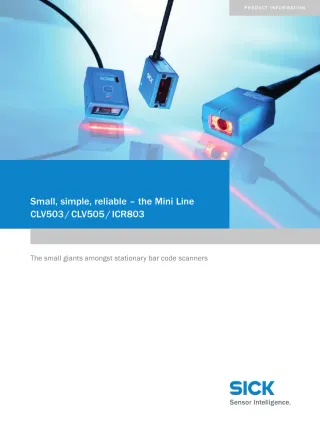
Small, simple, reliable: the Mini Line CLV503 / CLV505 / ICR803
Spec sheet16 pagesPDF 4.1 MB
Product information brochure for the SICK Mini Line compact bar code readers: the CLV503 and CLV505 laser scanners and the ICR803 image code reader.
Covers · 2 models
The models it covers
Summary
What is in it
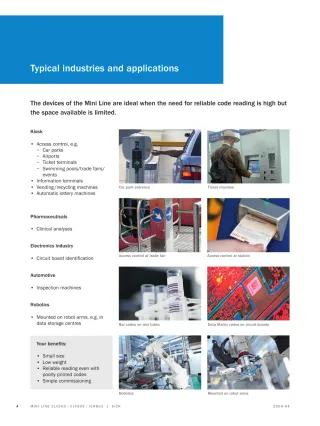
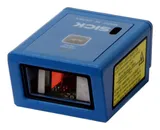
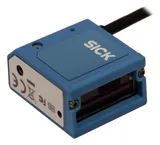
A product information brochure for the SICK Mini Line of very small stationary code readers: the CLV503 and CLV505 laser line and grid scanners and the ICR803 camera-based 2D image code reader. It describes typical applications such as kiosks, access control, clinical analysis and robotics, compares device features, and gives technical data, readable code types, dimensional drawings and reading field diagrams, ordering numbers, power supplies, accessories and configuration.
Its parts
- The Mini Line: CLV503, CLV505, ICR803
- Typical industries and applications
- The devices of the Mini Line
- Device features
- Product selection guide
- Technical data
- Readable code types and test codes
- Dimensional drawings and reading field diagrams CLV503 / CLV505
- Dimensional drawings and reading field diagrams ICR803
- Ordering information devices and power supply
- Accessories
- Configuration
From the sheet · read page by page
Key facts from this sheet
Each line names its page in the PDF.
A 16-page SICK product information brochure (8012891, 2009-04) for the Mini Line of small stationary code readers: the CLV503 and CLV505 laser bar code scanners and the ICR803 camera-based 2D image code reader. It covers typical applications, a selection guide, technical data, readable code types, dimensional drawings and reading fields, ordering numbers, accessories and configuration by bar code.
- Device
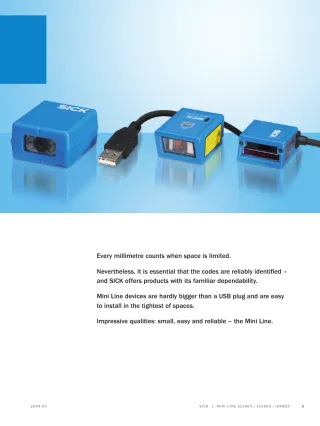
- Very small stationary laser bar code scanner (line or grid scanner) for tight spaces p. 3, 5
- Scanning frequency
- CLV503: 100 Hz; CLV505: 1,000 Hz with a rotating mirror wheel, for transport speeds up to 5 m/s p. 6
- Data interfaces
- USB keyboard wedge, USB serial, RS 232; 1.5 m cable with USB plug or open wire ends p. 8
- Operating voltage
- 5 V DC ± 10 % p. 8
- Power consumption
- CLV503: typ. 85 mA, max. 150 mA; CLV505: typ. 205 mA, max. 500 mA p. 8
- Laser and resolution
- Visible red laser diode (650 nm); resolution 0.15 mm to 1.0 mm p. 8
- Code types
- 1D and stacked bar codes, which must be aligned (the ICR803 reads in any orientation) p. 5, 6
- Switching I/O
- 1 input for the clock reading pulse; outputs 1 x GoodRead, 1 x NoRead p. 8
- Weight
- CLV503: 18.5 g without cable; CLV505: 30 g without cable p. 8
- Environment
- CLV503: –10 to 45 °C, 20 to 85 % humidity; CLV505: 0 to 45 °C, 5 to 90 % humidity, non-condensing p. 8
- Enclosure rating
- CLV503: IP 43; CLV505: IP 54 p. 8
- CLV503 order numbers
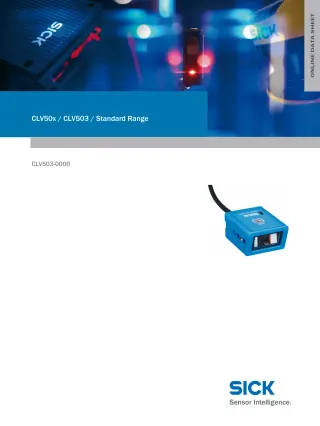
- 1046315 CLV503-0000 (open wire ends, RS 232); 1046316 CLV503-0110 (USB plug, USB VCP/HID) p. 12
- CLV505 order numbers
- Line scanner: 1046317 CLV505-0000 (RS 232), 1046318 CLV505-0110 (USB); grid scanner: 1046319 CLV505-1000 (RS 232), 1046320 CLV505-1110 (USB) p. 12
- Mounting brackets
- 2050021 for CLV503; 2050022 for CLV505; 2050023 for ICR803 p. 13
What this sheet walks you through
- Choosing between the CLV503, CLV505 and ICR803 p. 7
- Configuring a scanner by scanning configuration bar codes p. 14
- Using the online setup tool for expanded configuration p. 14
- Checking reading distance against code resolution in the reading field diagrams p. 10
- Checking which code types each device reads p. 9
Good to know
- CLV503-0110: ESD protection by grounded or ESD-safe mounting is required, and the USB cable must not exceed 3 m. p. 8
- CLV503-0000: the device must be mounted on an isolated support or protected from ESD. p. 8
- The CLV505's 5 m/s transport speed is application-dependent. p. 6
- The scanners are maintenance-free, but regular cleaning and adjustment is recommended. p. 15
Questions this sheet answers
What is the difference between the SICK CLV503 and CLV505?
The CLV503 scans at 100 Hz; the CLV505 uses a rotating mirror wheel for 1,000 Hz and faster conveyors, and also comes as a grid scanner. p. 6, 12
What voltage does the CLV503 need?
5 V DC ± 10 %, drawing typically 85 mA and at most 150 mA. p. 8
How do I configure a SICK CLV503 scanner?
By scanning configuration bar codes; the setup tool at http://setup-mini-line.sick.com prints bar codes for expanded settings. p. 14
Can the CLV503 read 2D codes?
The brochure lists 1D and stacked codes for the CLV503 and CLV505; 2D codes are read by the camera-based ICR803. p. 5
Contents
Chapters and sections
Each line opens the PDF at its page.
- The Mini Line: CLV503, CLV505, ICR8032
- Typical industries and applications4
- The devices of the Mini Line5
- Device features6
- Product selection guide7
- Technical data8
- Readable code types and test codes9
- Dimensional drawings and reading field diagrams CLV503 / CLV50510
- Dimensional drawings and reading field diagrams ICR80311
- Ordering information devices and power supply12
- Accessories13
- Configuration14
The whole text · 2 parts
Read the sheet here as text
Its text as extracted from the PDF, unedited, in parts; each page opens the PDF at that page.
The file