Manual · Symbol
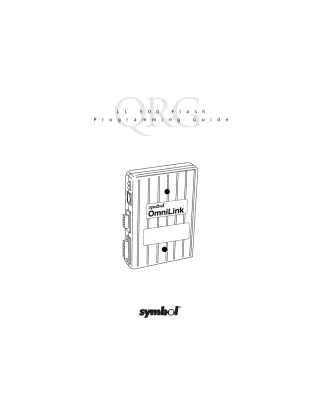
LL 500 Programming Flash Guide
Manual12 pagesPDF 74 KB
Flash programming guide for the Symbol LL 500 controller: downloading and uploading firmware and parameters with the Flash Utility.
Covers · 1 model
The models it covers
Summary
What is in it
Flash programming guide for the Symbol LL 500 controller. It explains how to install and run the Windows Flash Utility (flash.exe) to download or upload the LL 500's operational software and EEParameters over a serial port, the PC, cable and power supply requirements, setup steps, launch script syntax with operations and options, worked download and upload examples, and the error codes for script syntax and flash programming errors.
Its parts
- Purpose
- Installing the Flash Utility
- Operational Requirements
- Setup
- Flash Utility Operation
- Flash Operation Examples
- Flash-Operation Errors
From the manual · read page by page
Key facts from this manual
Each line names its page in the PDF.
Programming flash guide 70-35780-01 (Revision A, July 1998) for the Symbol LL 500, explaining the Flash Utility (flash.exe) that downloads and uploads LL 500 software through a PC serial port. It lists the cables, power supplies and files needed, the launch script operations and options, examples, and the error codes.
- Purpose
- Flash Utility for downloading and uploading software on LL 500s without external prom modules p. 3
- Programming cable
- LL 500 flash programming Pentapus adapter cable, Symbol p/n 25-31627-01, on the RS-232C aux port p. 4, 5
- Aux RS-232 cables
- 25-05395-01 (RS-232, TxD pin 2, male) or 25-04814-01 (RS-232, TxD pin 2, female) p. 5
- Power supplies
- Symbol p/n 50-04000-037, 50-04000-059, 50-04000-040, 50-04000-084, 50-04000-041, 50-04000-085 or 50-04000-058 p. 4
- PC needed
- PC (486 or better) running Windows, with a serial comm port p. 3
- Utility disk
- flash.exe on disk Symbol p/n 21-31012-01 p. 5
- Software files
- Operational software (example AKDBAH.FDL) and power-up operating parameters (example EEPS.FDL), in .FDL format; neither is on the utility diskette p. 3, 8
- Operations
- DL, DL-CODE and DL-EEPARAMS to download; UL, UL-CODE and UL-EEPARAMS to upload p. 7
- Baud rates
- 9600 to 153600 baud, default 153600; 57600 and 115200 not supported by the LL 500 p. 7
- Launch script
- flash <operation> [P1 P2...] NULL [f1 f2] p. 6
- Error codes
- Hex code at completion, zero for success; launch script syntax errors listed from 0x21 to 0x5F; 0x01 to 0x0E for flash programming errors, blinked by the LL 500 LED p. 10, 11
- Logging
- -L logs each operation and its error code to log.dat in the local directory p. 7, 10
What this manual walks you through
- Installing the Flash Utility on a PC p. 3
- Connecting the LL 500 to a PC for flash programming p. 5
- Writing launch scripts: operations, options and files p. 6, 7, 8
- Downloading operational software and EEParameters to the LL 500 p. 8, 9
- Uploading code, flash memory or EEParameters to a file p. 9
- Reading script syntax and flash programming error codes p. 10, 11
Good to know
- The guide restricts the Flash Utility to Symbol certified personnel, including VARs and service-trained customers. p. 3
- Use only .FDL files, and never components for a different LL 500 revision. p. 3
- Power the LL 500 before a first flash operation, and repower it after a failed one. p. 5
- A PC limited to 9600 baud needs the -B0 option, or the flash operation fails. p. 9
- Operation names and NULL in the launch script must be uppercase. p. 6, 7
Questions this manual answers
What cables do I need to flash a Symbol LL 500?
The Pentapus flash programming adapter cable (25-31627-01) on the aux port, plus a standard aux RS-232 cable (25-05395-01 or 25-04814-01) to the PC. p. 4, 5
What does LL 500 flash error 0x01 mean?
0x01 is a receive time-out error; flash programming errors are also blinked by the LL 500's LED. p. 11
How do I load new operational software into an LL 500?
Run flash.exe with a launch script such as Flash DL-CODE NULL followed by the product code file, for example AKDBAH.FDL. p. 8
What PC do I need to run the LL 500 Flash Utility?
A 486 or better PC running Windows with a serial comm port. p. 3
How do I save the LL 500 EEParameters to a file?
The guide's upload example reads the EEParameters into a file with the UL-EEPARAMS operation, for example into EEPS.DAT. p. 9
Contents
Chapters and sections
Each line opens the PDF at its page.
The whole text · 2 parts
Read the manual here as text
Its text as extracted from the PDF, unedited, in parts; each page opens the PDF at that page.
The file