Spec sheet · RFL
RFL 9745 Teleprotection Channel
Spec sheet13 pagesPDF 3.0 MB
Product information and specifications for the RFL 9745 programmable teleprotection channel for audio, digital and fiber optic links.
Covers · 1 model
The models it covers
Summary
What is in it
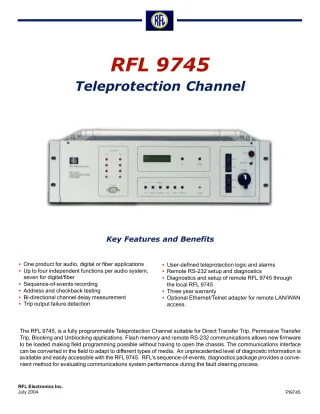
RFL Electronics' product information sheet for the RFL 9745 Teleprotection Channel, a fully programmable unit for direct transfer trip, permissive transfer trip, blocking and unblocking schemes over audio tone, digital or fiber optic media. It describes the applications, diagnostics and sequence-of-events recording, programmable logic and I/O, programming with PC APRIL and the RFL Expert System, audio, digital and fiber specifications, the short haul fiber interface, real time clock, I/O options, general specifications, chassis drawings and ordering information.
From the sheet · read page by page
Key facts from this sheet
Some pages are scans or cannot be read; this says only what the readable text supports. Each line names its page in the PDF.
RFL Electronics product information sheet PI9745, dated July 2004, for the RFL 9745 Teleprotection Channel, a programmable unit that carries Direct Transfer Trip, Permissive Transfer Trip, Blocking and Unblocking signals over audio tone, digital or fiber optic links. It gives the system, I/O and general specifications, sample parameter displays, chassis drawings and the ordering information.
- Device
- Programmable teleprotection channel for Direct Transfer Trip, Permissive Transfer Trip, Blocking and Unblocking p. 1
- Functions
- Up to four independent functions per audio system, seven for digital or fiber p. 1
- Audio interface
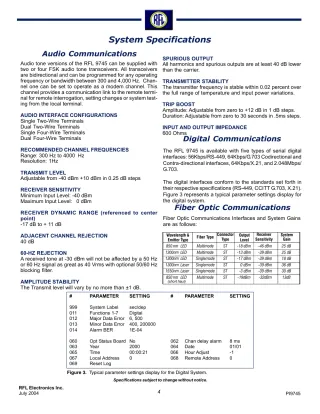
- Two or four FSK audio tone transceivers, 300 to 4,000 Hz; 600 Ohms; two-wire or four-wire p. 4
- Digital interfaces
- 56Kbps/RS-449, 64Kbps/G.703 codirectional and contra-directional, 64Kbps/X.21, 2.048Mbps/G.703 p. 4
- Short haul fiber
- 850 nm multimode pair up to 1 kilometer (3,280 feet), ST connectors, ANSI C37.94 compliant p. 5
- Power supply
- 48/125 Vdc supply: 38 to 150 Vdc; 250 Vdc supply: 170 to 300 Vdc; single or redundant p. 8
- RS-232 ports
- Front (DCE) and rear (DTE); 300 bps to 19.2 Kbps; eight data bits, one stop bit, no parity, XON/XOFF p. 6
- Telnet adapter
- Optional module with one Ethernet port and two RS232 ports (Craft and Data), in the right options bay p. 6
- I/O modules
- Up to two: Solid-State, Relay/Solid-State or HS Relay; each with four isolated inputs and three form C alarm contacts p. 6
- Solid-state outputs
- 1 ampere continuous, 2 amperes for one minute, 10 amperes for 100 msec; 280 Vdc maximum open-circuit p. 6
- Operate time
- Digital and fiber systems: 3 ms maximum in the most secure mode p. 8
- Temperature
- Operating -30° C to +65° C; storage -40° C to +75° C p. 8
- Chassis
- Standard 19-inch rack, three rack-units high (5.25 inches or 13.3 cm) p. 8
- Fiber service units
- P/N-107460-1 RS449, -2 V.35, -3 G.703, -4 X.21, -5 E1 (all 38-150 Vdc) p. 12
What this sheet walks you through
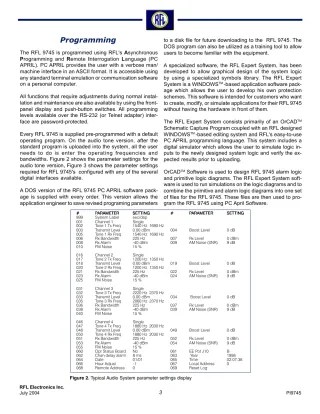
- Programming the RFL 9745 with PC APRIL and the RFL Expert System p. 3
- Typical parameter settings for audio tone and digital systems p. 3, 4
- Linking to a multiplexer over short haul fiber, directly or through a Fiber Optic Service Unit p. 5
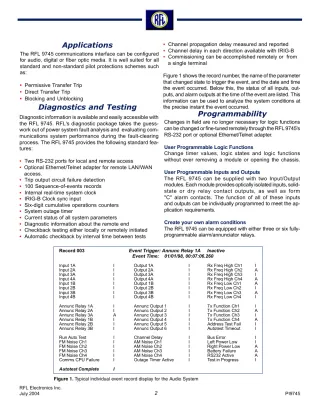
- Reading a sequence-of-events record p. 2
- Building an RFL 9745 part number from the ordering options p. 12
Good to know
- A fiber service unit must be ordered as a separate item. p. 12
- The two auxiliary relay option cannot be combined with the test panel or Telnet option. p. 12
- The front RS-232 port has priority over the rear port. p. 6
- The event recorder holds 100 events; after that, older events are overwritten. p. 6
- Rejection of a 50 or 60 Hz signal up to 40 Vrms needs the optional 50/60 Hz blocking filter. p. 4
Questions this sheet answers
What digital interfaces does the RFL 9745 support?
Five serial digital interfaces: 56Kbps/RS-449, 64Kbps/G.703 codirectional and contra-directional, 64Kbps/X.21 and 2.048Mbps/G.703. p. 4
How many events does the RFL 9745 store?
The sequence-of-events recorder stores up to 100 events, overwriting the oldest after that; the events log keeps up to 1,000,000 counts per item. p. 6
What baud rates does the RFL 9745 RS-232 port use?
300 bps, 1200 bps, 2400 bps, 9600 bps or 19.2 Kbps, selected with the front panel switches. p. 6
How do I connect an RFL 9745 to a multiplexer by fiber?
With the Short Haul Fiber Interface it talks directly to an ANSI C37.94 compliant multiplexer; otherwise a remote Fiber Optic Service Unit converts the optical signal to electrical. p. 5
Can the RFL 9745 be time-synced?
Yes. It accepts the IRIG-B time code on a 1kHz modulated carrier; under IRIG-B control the clock is accurate to ±1 msec. p. 6
The whole text · 2 parts
Read the sheet here as text
Its text as extracted from the PDF, unedited, in parts; each page opens the PDF at that page.
The file