Manual · Intermec
PEN*KEY 6100 Computer Programmer's Reference Guide
Manual328 pagesPDF 1.2 MB
Programmer's reference guide for the Intermec PEN*KEY 6100 pen computer: DOS and Windows drivers, power management and flash updates.
Filed with · 1 model
Also filed with these models on the old site
Summary
What is in it
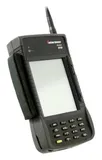
Intermec's programmer's reference for the PEN*KEY 6100 Computer, a pen-based handheld with a touch display, keypad and bar code scanning. It covers flash memory reprogramming, development environments for DOS and Windows, PC Card and SanDisk support, the DOS and Windows drivers for power management, pen, scanner and NPCP and IrDA printing, the APM power management BIOS, communications through Norand Utilities, converting 4000 Series applications, and system reference information such as the interrupt index.
Its parts
- Preface
- Getting Started
- Supporting DOS Applications
- Supporting Windows Applications
- Power Management
- Communications and Device Support
- Conversions and Interfaces
- Reference, System Information
- Reference, Open Systems Publications
From the manual
Key facts from this manual
Each line names its page in the PDF.
The PEN*KEY 6100 Computer Programmer's Reference Guide (P/N 977-054-001, Revision B), written for developers of DOS and Windows applications on the PEN*KEY 6100 Hand-Held Computer and updated for flash version 1.16. It describes the hardware as an application sees it, the development setup, reprogramming and customizing flash, drivers, power management, interrupts and system messages. It names the 6100 Computer throughout and never names the 6110 the site files it under.
- Device
- PEN*KEY 6100: ruggedized, battery-powered, touch-based hand-held computer with finger, stylus, keyboard or scanner input p. 24
- Processor
- AMD ELAN 386 33 MHz p. 24
- Operating system
- ROM DOS 5 (MS-DOS 5.0) with Windows 3.1 p. 24, 28
- Display
- Backlit touch-sensitive LCD, 1/4 VGA size (240 x 320 pixels), driven by a CGA controller p. 24
- Memory
- DRAM of 2, 4, 8 or 16 MB; 1 MB flash for flash version 1.11 and later p. 25, 28
- PC Card slots
- Two type II or one type III, for SRAM, flash or hard disk storage, radio or land modems p. 26
- Batteries
- One main and one backup battery; a discharged main battery recharges in 2 hours, a backup battery in 14 hours p. 25
- Ports
- Standard UART serial ports, IrDA printing, surface and pin connections for charging, printers and scanners; no external keyboard port p. 26
- PC Card modem port
- Default address 2E8h and IRQ 5 using NORMOD.SYS and CardSoft p. 252
- Tool Kit part numbers
- 215-598-001, 215-597-001, 215-600-001, 215-599-001 (DOS only or DOS and Windows, with or without manual) p. 26
- License part numbers
- NORAND Operating System P/N 999-001-014; MS-DOS and Microsoft Windows P/N 999-001-041; MS-DOS P/N 999-001-042 p. 27
- Flash load
- Flash version 1.16; IFL card image 61FL1000.BIN written with PROG.BAT p. 15, 29
- Development setup
- 2 MB RAM for DOS or 4 MB for Windows, 1 MB flash, a Tool Kit, a 2-MB SRAM card, PC Card reader/writer, NULL modem cable to the dock p. 28, 29
- User's guide
- PEN*KEY Model 6100 Hand-Held Computer User's Guide, P/N 961-028-085 p. 16
What this manual walks you through
- Updating the flash to version 1.16 with an IFL card p. 29, 30, 31
- Booting in master mode when the flash is blank or corrupted p. 31
- Building a custom flash image p. 31
- Setting up a minimum development configuration p. 28, 29
- Changing DOS and Windows configuration files after a flash update p. 29, 30
- Checking Tool Kit files with CRC32.EXE p. 27
- Reading system messages and audible beep codes at boot p. 251, 252
- COM port addresses, IRQs and COM1 connector pin-outs p. 252, 253
Good to know
- Keep the unit on charge during any setup, reprogramming or reflashing. p. 29
- The main battery must stay installed at all times, even in storage; the backup battery only holds RAM during a main battery change. p. 25
- On an 8 MB system, format the RAM drive to zero before a flash update, or the unit may lock up and need its DRAM board removed. p. 29
- Do not make the IFL card with DOS COPY or XCOPY; use PROG.BAT. p. 30
- A custom flash must not go beyond the 1 MB limit; the tool does not check it. p. 31
Questions this manual answers
How do I reflash a PEN*KEY 6100?
Write 61FL1000.BIN to a 2 MB or larger SRAM card with PROG.BAT, put the card in drive B (closest to the display) and press Reset, then follow the prompts. p. 30, 31
How long does the 6100 battery take to charge?
A discharged main battery takes 2 hours; a discharged backup battery takes 14 hours. p. 25
What processor does the PEN*KEY 6100 use?
An AMD ELAN 386 33 MHz processor. p. 24
Contents
Chapters and sections
Each line opens the PDF at its page.
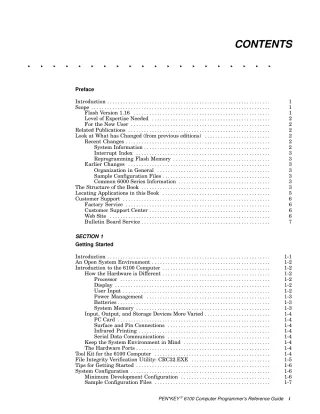
- Title1
- Preface15
- Section 1: Getting Started23
- Introduction23
- An Open System Environment24
- Introduction to the 6100 Computer24
- Tool Kit for the 6100 Computer26
- File Integrity Verification Utility: CRC32.EXE27
- Tips for Getting Started28
- System Configuration28
- Reprogramming Flash Memory29
- Development Environments33
- Setup for PC Development38
- Development Resources40
- Section 2: Supporting DOS Applications53
- Section 3: Supporting Windows Applications69
42 more lines, from page 98 on
- IrDA Printing for Windows: NOR6805.DRV98
- Section 4: Power Management103
- Section 5: Communications and Device Support113
- Section 6: Conversions and Interfaces137
- Introduction137
- Converting 4000 Series Applications139
- Power Management BIOS Interfaces: ELANAPM.EXE147
- 6100 BIOS Interfaces149
- 4000 Series Programming Interfaces: 4000API.EXE155
- 4000 Series Screen Emulation: VROTATE.EXE, FONTSEL.EXE160
- ATA BIOS: ATABIOS.SYS164
- Cross-Reference by Interrupt Numbers164
- Interrupt Definitions170
- Section 7: Reference, System Information245
- Section 8: Reference, Open Systems Publications259
- Appendix A: Sample Configuration Files263
- Appendix B: Common PEN*KEY 6000 Series Information281
- General Index313
- Files Index319
- Interrupt Index321
The whole text · 38 parts
Read the manual here as text
Its text as extracted from the PDF, unedited, in parts; each page opens the PDF at that page.
- Pages 1 to 71-7
- Pages 8 to 148-14
- Preface15-22
- Section 1: Getting Started, pages 23 to 3223-32
- Section 1: Getting Started, pages 33 to 4233-42
- Section 1: Getting Started, pages 43 to 5243-52
- Section 2: Supporting DOS Applications, pages 53 to 6053-60
- Section 2: Supporting DOS Applications, pages 61 to 6861-68
- Section 3: Supporting Windows Applications, pages 69 to 7769-77
- Section 3: Supporting Windows Applications, pages 78 to 8678-86
- Section 3: Supporting Windows Applications, pages 87 to 9587-95
- Section 3: Supporting Windows Applications, pages 96 to 10296-102
- Section 4: Power Management103-112
- Section 5: Communications and Device Support, pages 113 to 120113-120
- Section 5: Communications and Device Support, pages 121 to 128121-128
- Section 5: Communications and Device Support, pages 129 to 136129-136
- Section 6: Conversions and Interfaces, pages 137 to 146137-146
- Section 6: Conversions and Interfaces, pages 147 to 156147-156
- Section 6: Conversions and Interfaces, pages 157 to 166157-166
- Section 6: Conversions and Interfaces, pages 167 to 176167-176
- Section 6: Conversions and Interfaces, pages 177 to 186177-186
- Section 6: Conversions and Interfaces, pages 187 to 196187-196
- Section 6: Conversions and Interfaces, pages 197 to 206197-206
- Section 6: Conversions and Interfaces, pages 207 to 216207-216
- Section 6: Conversions and Interfaces, pages 217 to 226217-226
- Section 6: Conversions and Interfaces, pages 227 to 236227-236
- Section 6: Conversions and Interfaces, pages 237 to 244237-244
- Section 7: Reference, System Information245-258
- Section 8: Reference, Open Systems Publications259-262
- Appendix A: Sample Configuration Files, pages 263 to 271263-271
- Appendix A: Sample Configuration Files, pages 272 to 280272-280
- Appendix B: Common PEN*KEY 6000 Series Information, pages 281 to 288281-288
- Appendix B: Common PEN*KEY 6000 Series Information, pages 289 to 296289-296
- Appendix B: Common PEN*KEY 6000 Series Information, pages 297 to 304297-304
- Appendix B: Common PEN*KEY 6000 Series Information, pages 305 to 312305-312
- General Index313-318
- Pages 319 to 326319-326
- Pages 327 to 328327-328
The file