Manual · MagTek
I/O Interface for TTL Magnetic Stripe Readers Technical Reference Manual
Manual34 pagesPDF 1.1 MB
MagTek technical reference on interfacing TTL magnetic stripe card readers to a CPU: track data formats, encoding, LRC and error checks.
Filed with · 1 model
Also filed with these models on the old site
Summary
What is in it
Technical reference manual from MagTek on reading data from TTL magnetic stripe readers such as its swipe and insertion readers. It explains how to wire the strobe, data and card present lines to a CPU, the Track 1, 2 and 3 data formats, F2F encoding and timing, LRC calculation, error checking (including an Intel 8751 example), bidirectional reading and amplitude variations, with appendices on character conversion, the read IC 21006516 spec sheet, card standards and interfacing the reader to a microprocessor.
Its parts
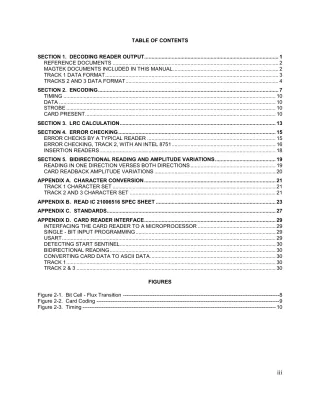
- Section 1. Decoding Reader Output
- Section 2. Encoding
- Section 3. LRC Calculation
- Section 4. Error Checking
- Section 5. Bidirectional Reading and Amplitude Variations
From the manual
Key facts from this manual
Each line names its page in the PDF.
A MagTek technical reference manual on the I/O interface of TTL magnetic stripe readers in general. It does not describe the 101mm Swipe Reader on its own, but lists that reader's manual among its reference documents. It explains the card present, strobe and data signals, the card track formats, parity and LRC checks, and includes the spec sheet of the 21006516 read IC.
- Document
- Manual Part Number 99875148 Rev-6, December 2003 p. 1
- 101mm reader manual
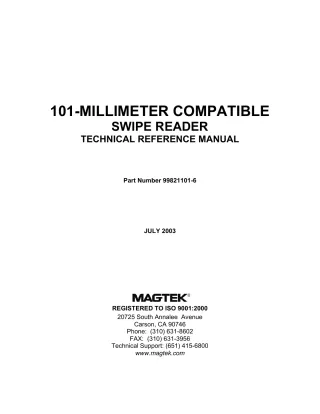
- 101-millimeter Compatible Swipe Reader Technical Reference Manual, P/N 99821101 p. 6
- Reader signals
- Strobe, data and card present lines, all quiescently high (Vcc) p. 5
- Card Present timing
- Goes low after 14/15 flux reversals; returns high 150 milliseconds after the last flux reversal p. 14
- Data logic
- Data high = zero bit, data low = one bit; valid while the strobe is low p. 14
- Track 1 format
- Up to 76 alphanumeric characters, 7-bit (6 plus parity), odd parity, start sentinel %, end sentinel ? p. 7
- Tracks 2 and 3 format
- Up to 37 (Track 2) or 104 (Track 3) numeric characters, 5-bit (4 plus parity), odd parity p. 8
- Bit density
- Track 1: 210 bits per inch; Track 2: 75 bits per inch (F2F encoding) p. 11
- Character limits
- Some readers give an error above track 1 = 79, track 2 = 40, track 3 = 107 characters p. 19
- Read IC
- 21006516 F/2F read/decode IC (SOIC), 150 to more than 12,000 bits per second p. 27
- Read IC power
- 2.7 to 5.5 volts, current below 2.0 mA p. 27
- Read IC temperature
- Operates from -30° to 70°C p. 28
- Read IC outputs
- TTL/CMOS compatible: Card Present, Read Data, Strobe and F/2F p. 28
- Read IC reset
- Resets itself about 150 milliseconds after the last flux reversal, or by a 1.0 to 100 microsecond pulse on RESET p. 29
What this manual walks you through
- Connecting the strobe, data and card present lines to a CPU p. 5
- Decoding Track 1 data and calculating odd parity and the LRC p. 7, 8
- Decoding Track 2 and Track 3 data p. 8, 9
- How F2F encoding places flux transitions on the stripe p. 11, 12, 13
- Signal timing of Card Present, Strobe and Data p. 14
- Error checks a typical reader performs p. 19
- Track 2 error-checking code for an Intel 8751 CPU p. 20, 21
- Reading cards in insertion readers p. 22
- Reading cards in both directions p. 23, 24
- Checking readback amplitude with a scope p. 24
Good to know
- On insertion readers, reading is most reliable on the card withdrawal stroke. p. 22
- Track 1 example data uses capital letters only. p. 7
- Read IC performance figures apply when used with MagTek read heads and the recommended circuit. p. 27
- On the read IC board layout, digital signals must not pass near the first four analog signals. p. 29
- Read in reverse, the boundary between trailing zeros and the LRC character cannot be told apart easily. p. 23
Questions this manual answers
What signals does a TTL swipe card reader output?
Card Present, Strobe and Data. All three are high (Vcc) when idle, and the strobe is meant to drive an interrupt on its falling edge. p. 5
When does Card Present go low and return high?
It goes low after 14/15 flux reversals from the head and returns high 150 milliseconds after the last flux reversal. p. 14
How many characters can Track 2 hold?
Up to 37 numeric characters on Track 2, against 104 on Track 3 and 76 alphanumeric characters on Track 1. p. 7, 8
What supply voltage does the 21006516 read IC need?
It runs from 2.7 to 5.5 volts with a current below 2.0 mA. p. 27
What is the part number of the 101mm swipe reader manual?
This manual lists the 101-millimeter Compatible Swipe Reader Technical Reference Manual as P/N 99821101. p. 6
Contents
Chapters and sections
Each line opens the PDF at its page.
- SECTION 1. DECODING READER OUTPUT5
- SECTION 2. ENCODING11
- SECTION 3. LRC CALCULATION17
- SECTION 4. ERROR CHECKING19
- SECTION 5. BIDIRECTIONAL READING AND AMPLITUDE VARIATIONS23
- APPENDIX A. CHARACTER CONVERSION25
- APPENDIX B. READ IC 21006516 SPEC SHEET27
- APPENDIX C. STANDARDS31
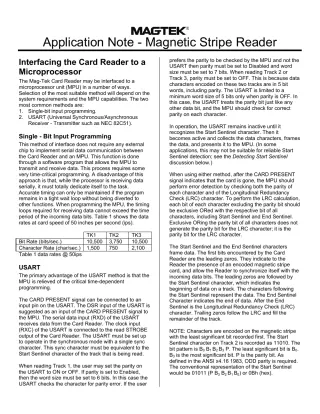
- APPENDIX D. CARD READER INTERFACE33
The whole text · 7 parts
Read the manual here as text
Its text as extracted from the PDF, unedited, in parts; each page opens the PDF at that page.
The file