Manual · Unitech
Hand Held Scanner User's Manual
Manual55 pagesPDF 205 KB
User's manual for the Unitech hand-held bar code scanner: keyboard, USB, RS232, terminal and wand interfaces, setup and data editing.
Filed with · 1 model
Also filed with these models on the old site
Summary
What is in it
User's manual for a Unitech hand-held scanner with a built-in decoder. It explains installing the scanner as a keyboard wedge (PC/AT, keyboardless PCs, Macintosh), as a USB device, as an RS232 serial or serial TTL device, as a terminal wedge and in wand emulation, and the operating parameters of each. Later chapters cover bar code menu setup, quick and batch setup, output data editing with formulas, pin assignments and specifications, with setup menus and function code charts in the appendices.
Its parts
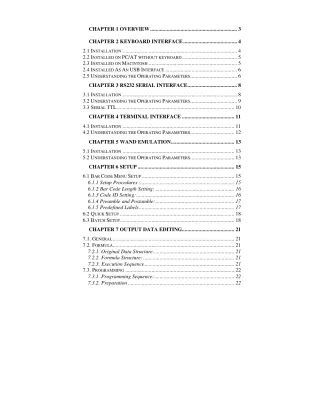
- Overview
- Keyboard Interface
- RS232 Serial Interface
- Terminal Interface
- Wand Emulation
- Setup
- Output Data Editing
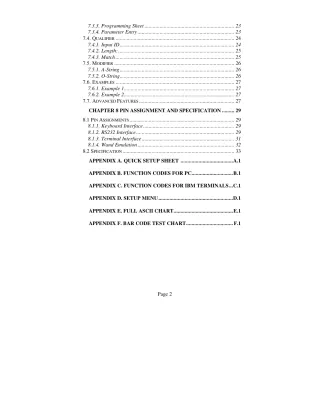
- Pin Assignment and Specification
From the manual
Key facts from this manual
Each line names its page in the PDF.
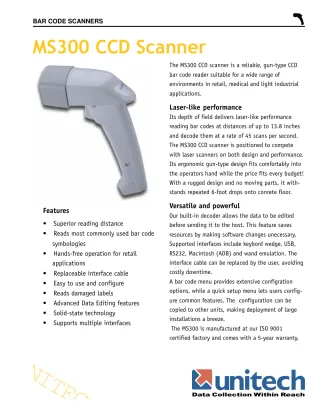
This is the Unitech Hand Held Scanner User's Manual (version 2.0, January 2000) for a hand held scanner with a built-in decoder; it names no model number. It shows how to install the scanner as a keyboard wedge, USB, RS232 serial, terminal wedge or wand emulation scanner and how to set it up with bar code menus. It also gives connector pinouts and basic specifications.
- Interfaces
- Keyboard wedge, RS232 serial wedge, RS232 terminal wedge, wand emulation and USB p. 4
- Symbologies
- Code 39 Standard and Full ASCII, Codabar, UPC/EAN with supplements, UCC/EAN128, Interleaved 2 of 5, Code 32, Standard 2 of 5, Code 93, MSI, Code 128, Plessey, Label Code IV and V, China Postal Code (Toshiba Code), Delta Distance Code p. 4
- Connector
- 10-pin modular (RJ45) connector at the bottom of the scanner handle p. 5, 30
- Power
- +5V ±5% DC p. 33
- Serial settings
- 300 to 38400 bps; default 9600 baud, no parity, 8 data bits; optional CTS/RTS handshaking p. 10
- Keyboard default
- IBM PC/AT and PS/2 p. 6
- Other keyboard hosts
- Macintosh ADB port; PC or iMac USB port; PC/AT or laptop without a keyboard p. 6, 7
- Terminal wedge
- Needs a DB25 RS232 cable, a terminal wedge Y cable and an AC adapter; full duplex, half duplex or block mode p. 12, 13
- Wand emulation
- Code 39 output (device number 07) or native output (device number 26); minimum bar or space duration 200 or 600 microseconds p. 14, 15
- Serial TTL
- RS232 data format with TTL output from 0V to 5V p. 11
- Standard RS232 cable
- Special adapter cable from the manufacturer, DB25 or DB9 female end p. 31
- Settings memory
- Non-volatile, kept when power is lost p. 16
- Humidity
- 0% to 95% relative humidity p. 34
- Manual version
- Version 2.0, January 2000 p. 1
What this manual walks you through
- Installing the scanner as a keyboard wedge with the Y cable p. 5, 6
- Connecting to a Macintosh ADB or USB port p. 6, 7
- Installing as an RS232 serial scanner and matching baud rate, parity and data bits p. 9, 10
- Installing as a terminal wedge and setting data direction p. 12, 13
- Choosing wand emulation output settings p. 14, 15
- Changing settings with the bar code setup menu p. 16
- Setting bar code lengths, code IDs, preamble and postamble p. 17, 18
- Copying one scanner's settings to other scanners p. 19
- Connector pinouts for each interface p. 30, 31, 32, 33, 34
Good to know
- A setting of 7 data bits with no parity is treated as 7 data bits with MARK parity. p. 10
- On the TTL RS232 connector, CTS and RXD take 0V to 5V only and should not be connected to a standard RS232 port. p. 31
- The standard RS232 adapter cable is a special cable that cannot be replaced by others. p. 31
- The keyboardless feature may not work properly on some laptop computers. p. 6
- The three predefined labels share only 24 characters in total. p. 19
Questions this manual answers
What is the default keyboard setting of the Unitech hand held scanner?
IBM PC/AT and PS/2. p. 6
What baud rates does the scanner support on RS232?
300, 600, 1200, 2400, 4800, 9600, 19200 or 38400 bps; the default is 9600 baud, no parity, 8 data bits. p. 10
Does the scanner need a power adapter on an RS232 port?
Yes, unless the host supplies power at its RS232 port, which can be connected to pin 9 of the scanner connector. p. 9
How do I copy settings from one scanner to others?
Use batch setup: make custom setup labels from the master scanner and scan them with the other scanners. p. 19
What does a long beep mean when the scanner powers up on RS232?
It means the scanner is ready to use. p. 9
The whole text · 6 parts
Read the manual here as text
Its text as extracted from the PDF, unedited, in parts; each page opens the PDF at that page.
The file