Spec sheet · Philips
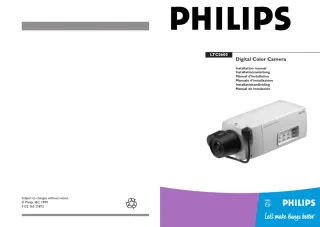
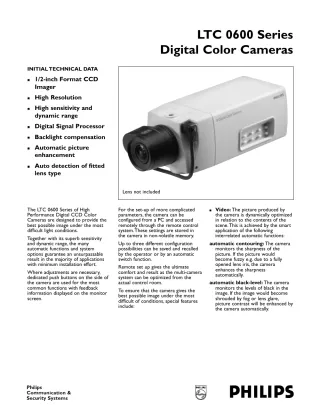
Philips LTC0600 Spec Sheet
Spec sheet3 pagesPDF 72 KB
All 3 pages are below, each with its text.
Covers · 1 model
The models it covers
From the sheet · read page by page
Key facts from this sheet
Each line names its page in the PDF.
Initial technical data sheet for the Philips LTC 0600 Series digital color CCD cameras, covering the LTC 0600/10, /20, /50 and /60 versions. It describes the automatic picture functions, programmable modes, outputs, synchronization and lens handling, and lists electrical, environmental and mechanical specifications and accessories.
- Device
- Digital color CCD camera, 1/2-inch format, lens not included p. 1
- Horizontal resolution
- 480 TVL p. 2
- Video outputs
- Composite on BNC (1 Vpp into 75 ohms); balanced or Y/C on a 4-pole mini DIN p. 2
- Power connection
- LTC -/10 and -/20: screw terminals; LTC -/50: cord with Euro plug; LTC -/60: cord with polarized plug p. 3
- Serial port
- RS232 on a 9-pole Sub D, 1200, 2400 or 4800 baud p. 3
- Software
- LTC 0650/00 configuration software for Windows 3.x and Windows 95/NT p. 3
- Lens mount
- C and CS; manual iris, DC-iris or video-iris lens detected automatically p. 2, 3
- Lens weight limit
- 1.5 kg (3.3 lb) bottom mounting, 0.5 kg (1.1 lb) top mounting p. 3
- Synchronization
- Line-lock (AC supply only), crystal-lock, V-lock or gen lock p. 3
- Programmable modes
- Three stored set-ups, recalled remotely or by closing an input contact p. 2
- Text in picture
- 24 characters, three strings stored p. 2
- Operating temperature
- -10 to 55°C (14 to 131 °F); humidity 5% to 93% non-condensing p. 3
- Dimensions and weight
- 65 x 70 x 149 mm (HxWxD, with connectors); 0.6 kg (1.32 lb) p. 3
- Camera mounting
- Top and bottom, 1/4" 20 UNC p. 3
What this sheet walks you through
- Automatic picture functions: contouring, black level, backlight, light control and white balance p. 1, 2
- Programming the camera from a PC or the remote control system p. 2
- Synchronization options and phase adjustment p. 3
- Connectors, controls and accessories p. 3
Good to know
- The lens is not included. p. 1
- Line-lock works only on an AC supply. p. 3
- The sheet is marked as initial technical data. p. 1
Questions this sheet answers
What lens mount does the Philips LTC 0600 use?
It takes C and CS mount lenses, and detects manual iris, DC-iris or video-iris lenses automatically. p. 2, 3
How do I configure the LTC 0600 from a PC?
Through its RS232 port (9-pole Sub D) with the LTC 0650/00 configuration software. p. 3
Does the LTC 0600 have an S-Video output?
Yes. Besides the BNC composite output, a 4-pole mini DIN gives balanced video or Y/C. p. 2
How heavy a lens can the LTC 0600 carry?
Up to 1.5 kg (3.3 lb) when bottom mounted and 0.5 kg (1.1 lb) when top mounted. p. 3
The file
Size and text
Every page · 3
Read it here
Each page as it is printed, and its words beside it, so a phone can search and copy them.
Page1of 3
Open in the PDF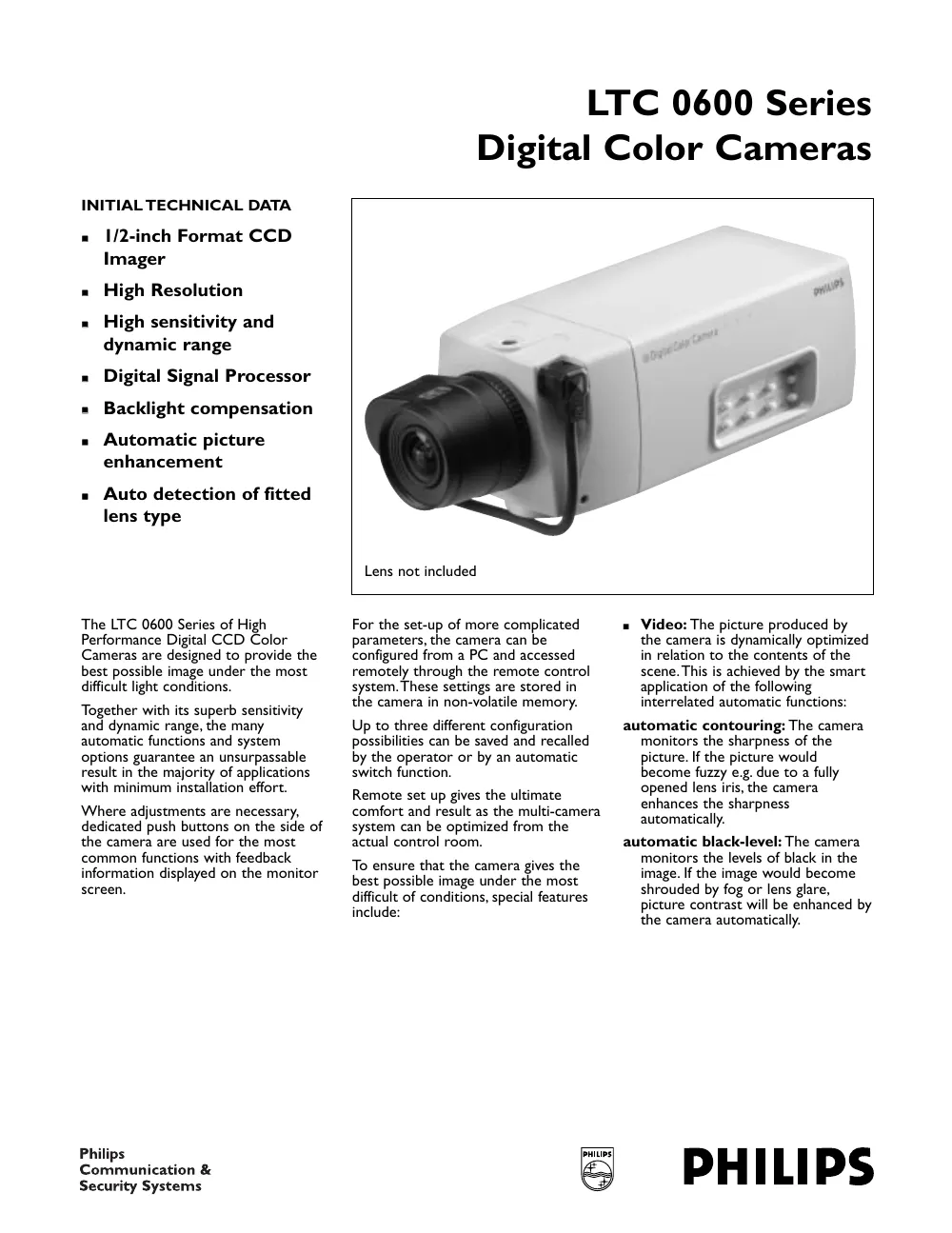
The text of page 1, from the PDF itself
LTC 0600 Series Digital Color Cameras INITIAL TECHNICAL DATA n
1/2-inch Format CCD Imager
nHigh Resolutionn
High sensitivity and dynamic range
n
Digital Signal Processor
nBacklight compensationn
Automatic picture enhancement
n
Auto detection of fitted lens type Lens not included
The LTC 0600 Series of High Performance Digital CCD Color Cameras are designed to provide the best possible image under the most difficult light conditions. Together with its superb sensitivity and dynamic range, the many automatic functions and system options guarantee an unsurpassable result in the majority of applications with minimum installation effort. Where adjustments are necessary, dedicated push buttons on the side of the camera are used for the most common functions with feedback information displayed on the monitor screen.
For the set-up of more complicated parameters, the camera can be configured from a PC and accessed remotely through the remote control system.These settings are stored in the camera in non-volatile memory. Up to three different configuration possibilities can be saved and recalled by the operator or by an automatic switch function. Remote set up gives the ultimate comfort and result as the multi-camera system can be optimized from the actual control room. To ensure that the camera gives the best possible image under the most difficult of conditions, special features include:
Video: The picture produced by the camera is dynamically optimized in relation to the contents of the scene.This is achieved by the smart application of the following interrelated automatic functions: automatic contouring: The camera monitors the sharpness of the picture. If the picture would become fuzzy e.g. due to a fully opened lens iris, the camera enhances the sharpness automatically. automatic black-level: The camera monitors the levels of black in the image. If the image would become shrouded by fog or lens glare, picture contrast will be enhanced by the camera automatically.
Page2of 3
Open in the PDF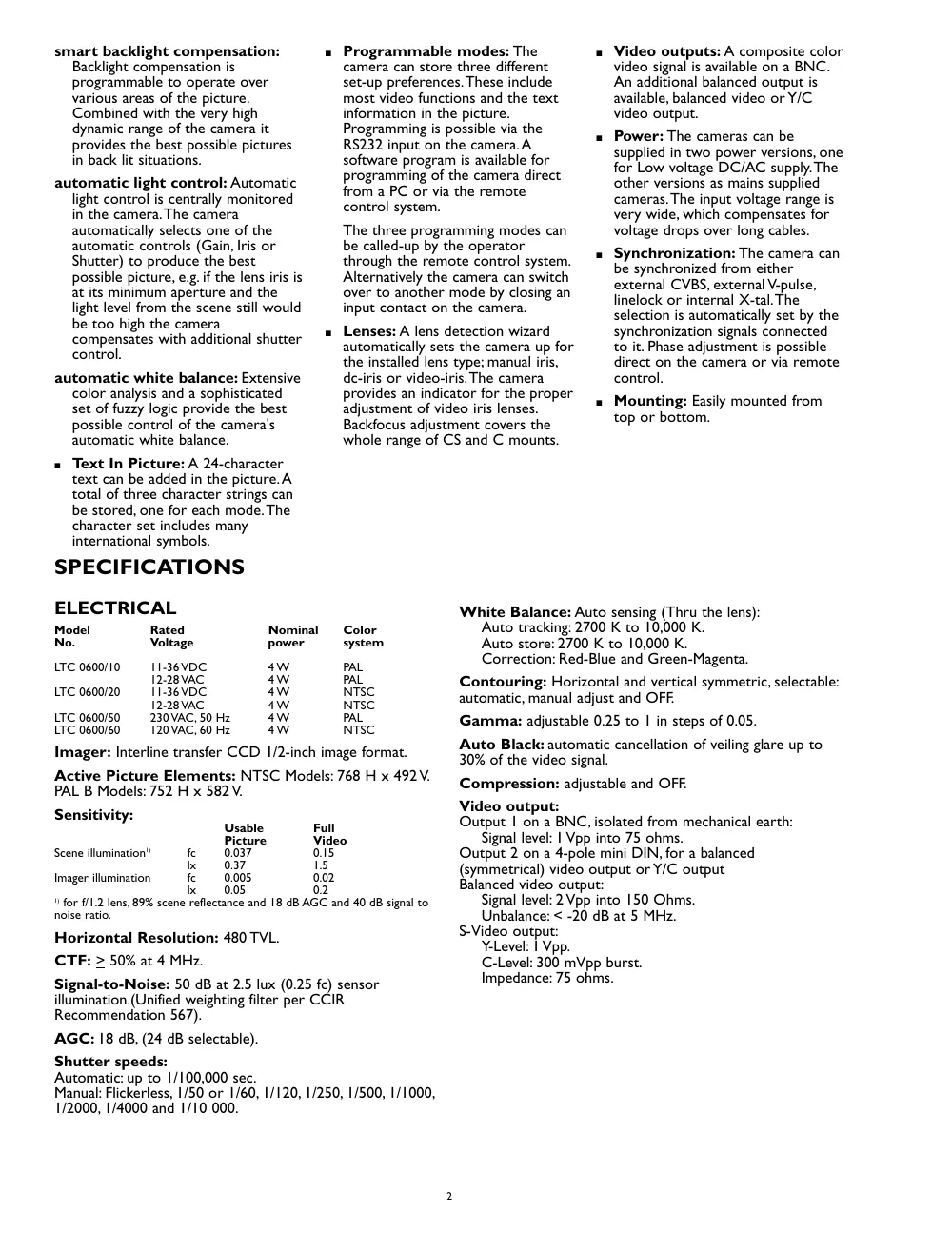
The text of page 2, from the PDF itself
smart backlight compensation: Backlight compensation is programmable to operate over various areas of the picture. Combined with the very high dynamic range of the camera it provides the best possible pictures in back lit situations. automatic light control: Automatic light control is centrally monitored in the camera.The camera automatically selects one of the automatic controls (Gain, Iris or Shutter) to produce the best possible picture, e.g. if the lens iris is at its minimum aperture and the light level from the scene still would be too high the camera compensates with additional shutter control. automatic white balance: Extensive color analysis and a sophisticated set of fuzzy logic provide the best possible control of the camera's automatic white balance.
- Text In Picture: A 24-character text can be added in the picture. A total of three character strings can be stored, one for each mode.The character set includes many international symbols.
Programmable modes: The camera can store three different set-up preferences.These include most video functions and the text information in the picture. Programming is possible via the RS232 input on the camera. A software program is available for programming of the camera direct from a PC or via the remote control system. The three programming modes can be called-up by the operator through the remote control system. Alternatively the camera can switch over to another mode by closing an input contact on the camera. Lenses: A lens detection wizard automatically sets the camera up for the installed lens type; manual iris, dc-iris or video-iris.The camera provides an indicator for the proper adjustment of video iris lenses. Backfocus adjustment covers the whole range of CS and C mounts.
Video outputs: A composite color video signal is available on a BNC. An additional balanced output is available, balanced video or Y/C video output. Power: The cameras can be supplied in two power versions, one for Low voltage DC/AC supply.The other versions as mains supplied cameras.The input voltage range is very wide, which compensates for voltage drops over long cables. Synchronization: The camera can be synchronized from either external CVBS, external V-pulse, linelock or internal X-tal.The selection is automatically set by the synchronization signals connected to it. Phase adjustment is possible direct on the camera or via remote control. Mounting: Easily mounted from top or bottom.
SPECIFICATIONS ELECTRICAL Model No.
Rated VoltageNominal powerColor systemLTC 0600/10
11-36 VDC 12-28 VAC 11-36 VDC 12-28 VAC 230 VAC, 50 Hz 120 VAC, 60 Hz
4W 4W 4W 4W 4W 4W
PAL PAL NTSC NTSC PAL NTSC
LTC 0600/20 LTC 0600/50 LTC 0600/60
White Balance: Auto sensing (Thru the lens): Auto tracking: 2700 K to 10,000 K. Auto store: 2700 K to 10,000 K. Correction: Red-Blue and Green-Magenta. Contouring: Horizontal and vertical symmetric, selectable: automatic, manual adjust and OFF. Gamma: adjustable 0.25 to 1 in steps of 0.05. Auto Black: automatic cancellation of veiling glare up to 30% of the video signal. Compression: adjustable and OFF. Video output: Output 1 on a BNC, isolated from mechanical earth: Signal level: 1 Vpp into 75 ohms. Output 2 on a 4-pole mini DIN, for a balanced (symmetrical) video output or Y/C output Balanced video output: Signal level: 2 Vpp into 150 Ohms. Unbalance: < -20 dB at 5 MHz. S-Video output: Y-Level: 1 Vpp. C-Level: 300 mVpp burst. Impedance: 75 ohms.
Imager: Interline transfer CCD 1/2-inch image format. Active Picture Elements: NTSC Models: 768 H x 492 V. PAL B Models: 752 H x 582 V. Sensitivity: Usable Full Picture Video Scene illumination1) fc 0.037 0.15 lx 0.37 1.5 Imager illumination fc 0.005 0.02 lx 0.05 0.2 1) for f/1.2 lens, 89% scene reflectance and 18 dB AGC and 40 dB signal to noise ratio.
Horizontal Resolution: 480 TVL. CTF: > 50% at 4 MHz. Signal-to-Noise: 50 dB at 2.5 lux (0.25 fc) sensor illumination.(Unified weighting filter per CCIR Recommendation 567). AGC: 18 dB, (24 dB selectable). Shutter speeds: Automatic: up to 1/100,000 sec. Manual: Flickerless, 1/50 or 1/60, 1/120, 1/250, 1/500, 1/1000, 1/2000, 1/4000 and 1/10 000.
2
Page3of 3
Open in the PDF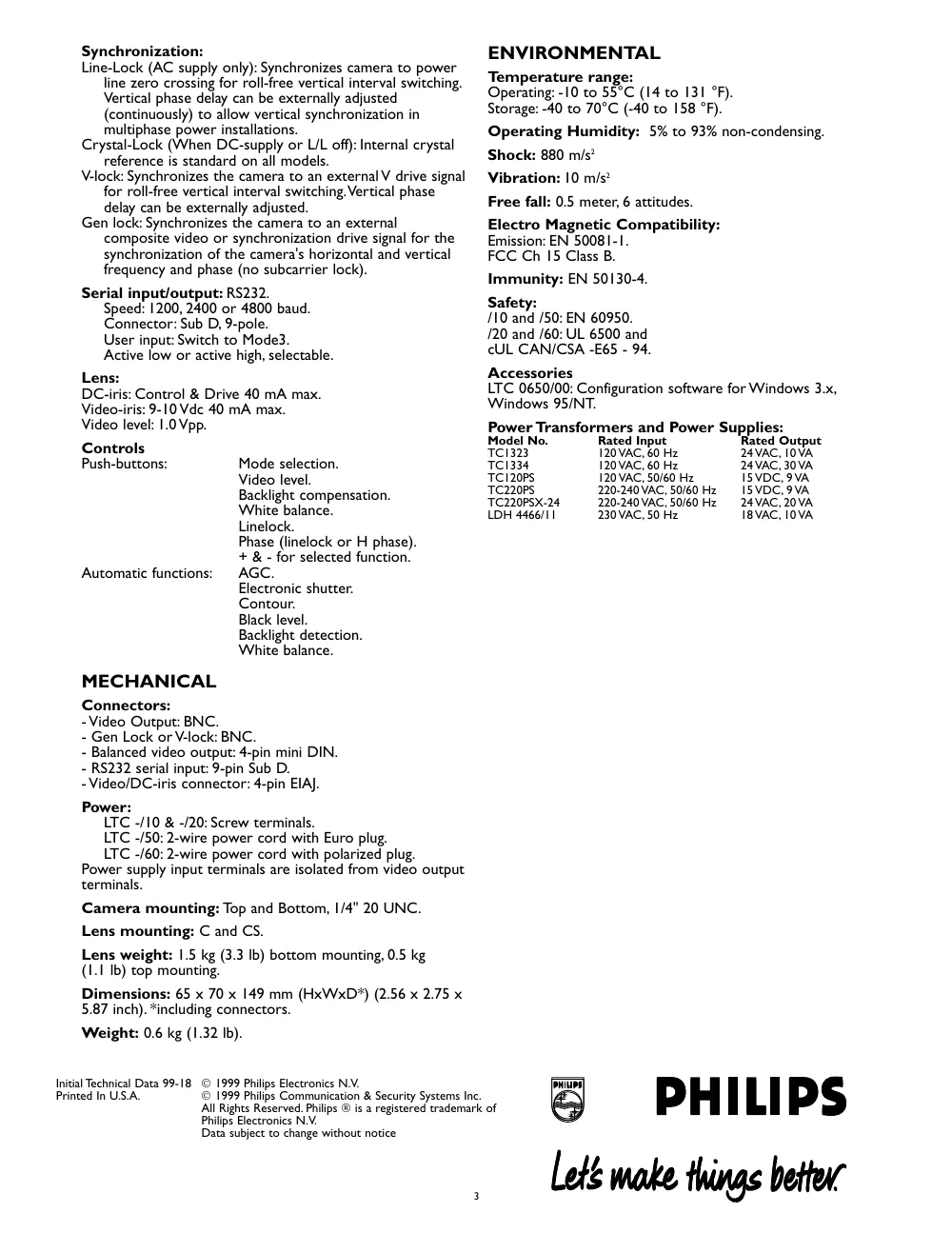
The text of page 3, from the PDF itself
Synchronization: Line-Lock (AC supply only): Synchronizes camera to power line zero crossing for roll-free vertical interval switching. Vertical phase delay can be externally adjusted (continuously) to allow vertical synchronization in multiphase power installations. Crystal-Lock (When DC-supply or L/L off): Internal crystal reference is standard on all models. V-lock: Synchronizes the camera to an external V drive signal for roll-free vertical interval switching.Vertical phase delay can be externally adjusted. Gen lock: Synchronizes the camera to an external composite video or synchronization drive signal for the synchronization of the camera's horizontal and vertical frequency and phase (no subcarrier lock). Serial input/output: RS232. Speed: 1200, 2400 or 4800 baud. Connector: Sub D, 9-pole. User input: Switch to Mode3. Active low or active high, selectable. Lens: DC-iris: Control & Drive 40 mA max. Video-iris: 9-10 Vdc 40 mA max. Video level: 1.0 Vpp. Controls Push-buttons: Mode selection. Video level. Backlight compensation. White balance. Linelock. Phase (linelock or H phase).
- & - for selected function. Automatic functions: AGC. Electronic shutter. Contour. Black level. Backlight detection. White balance.
ENVIRONMENTAL Temperature range: Operating: -10 to 55°C (14 to 131 °F). Storage: -40 to 70°C (-40 to 158 °F). Operating Humidity: 5% to 93% non-condensing. Shock: 880 m/s2 Vibration: 10 m/s2 Free fall: 0.5 meter, 6 attitudes. Electro Magnetic Compatibility: Emission: EN 50081-1. FCC Ch 15 Class B. Immunity: EN 50130-4. Safety: /10 and /50: EN 60950. /20 and /60: UL 6500 and cUL CAN/CSA -E65 - 94. Accessories LTC 0650/00: Configuration software for Windows 3.x, Windows 95/NT. Power Transformers and Power Supplies: Model No. TC1323 TC1334 TC120PS TC220PS TC220PSX-24 LDH 4466/11
MECHANICAL Connectors:
- Video Output: BNC.
- Gen Lock or V-lock: BNC.
- Balanced video output: 4-pin mini DIN.
- RS232 serial input: 9-pin Sub D.
- Video/DC-iris connector: 4-pin EIAJ. Power: LTC -/10 & -/20: Screw terminals. LTC -/50: 2-wire power cord with Euro plug. LTC -/60: 2-wire power cord with polarized plug. Power supply input terminals are isolated from video output terminals. Camera mounting: Top and Bottom, 1/4" 20 UNC. Lens mounting: C and CS. Lens weight: 1.5 kg (3.3 lb) bottom mounting, 0.5 kg (1.1 lb) top mounting. Dimensions: 65 x 70 x 149 mm (HxWxD*) (2.56 x 2.75 x 5.87 inch). *including connectors. Weight: 0.6 kg (1.32 lb). Initial Technical Data 99-18 Printed In U.S.A.
Ó 1999 Philips Electronics N.V. Ó 1999 Philips Communication & Security Systems Inc. All Rights Reserved. Philips Ò is a registered trademark of Philips Electronics N.V. Data subject to change without notice
3
Rated Input 120 VAC, 60 Hz 120 VAC, 60 Hz 120 VAC, 50/60 Hz 220-240 VAC, 50/60 Hz 220-240 VAC, 50/60 Hz 230 VAC, 50 Hz
Rated Output 24 VAC, 10 VA 24 VAC, 30 VA 15 VDC, 9 VA 15 VDC, 9 VA 24 VAC, 20 VA 18 VAC, 10 VA