Spec sheet · Allied Telesis
Allied Telesis AT-WA7500 and Intermec WA7500 Spec Sheet
Spec sheet2 pagesPDF 70 KB
Both pages are below, each with its text.
Names · 1 model
The models it names
Filed with · 1 model
Also filed with these models on the old site
From the sheet · read page by page
Key facts from this sheet
Each line names its page in the PDF.
This two-page datasheet is printed by Allied Telesis for the AT-WA7500, a dual radio wireless access point for the 2.4GHz and 5GHz bands; it never names Intermec or the WA7500 designation. It lists the radio options and ordering codes, power over Ethernet input, security and management features, and the physical and environmental specifications.
- Device
- Dual radio wireless access point, IEEE 802.11a, 802.11b and 802.11g p. 1
- Radio options
- Single radio A, B or G; dual radios AA, AB, BB, AG or GG (ordering code AT-WA7500xx/aa) p. 1
- Region codes
- NA North America; EU Europe; MSF p. 1
- Data rate
- Up to 54Mbps p. 1
- Ethernet
- 10/100Mbps p. 2
- Power
- Power over Ethernet, 36 to 57vDC, 350 mA @ 48 volts, IEEE 802.3af p. 2
- 802.11a radio
- 5.15 to 5.35GHz, OFDM, integrated antenna p. 1, 2
- 802.11b radio
- 2.4GHz, Direct Sequence Spread Spectrum, 11Mbps, 15 dBm p. 2
- Security
- WPA, WPA-PSK, WEP64 and WEP128, IEEE 802.1x, EAP/TLS, EAP/TTLS, embedded RADIUS server p. 1, 2
- Management
- Web browser, serial port, Telnet, SNMPv1; Avalanche Enabler remote management p. 1, 2
- Software upgrades
- By web browser or TFTP over the network or serial port p. 2
- Operating temperature
- -20°C to +55°C with an IEEE 802.11b radio; other radios vary p. 2
- Dimensions
- 38mm (H) x 250mm (L) x 159mm (D) p. 2
- Weight
- 0.625kg (1.38lbs) p. 2
What this sheet walks you through
- Choosing a single or dual radio configuration by ordering code p. 1
- Comparing 802.11a range and receiver sensitivity by data rate p. 2
- Controlling network access with MAC address lists, VLANs and multiple SSIDs p. 1
Good to know
- Each IEEE 802.11b radio needs at least one basic antenna ordered separately; without it the radio will not work to specification. p. 1
- SNMPv3 is marked as available at a later date. p. 2
- The operating temperature given applies with an IEEE 802.11b radio; other radio options vary. p. 2
Questions this sheet answers
Can the WA7500 access point run on Power over Ethernet?
Yes. It takes Power over Ethernet at 36 to 57vDC, 350 mA @ 48 volts, with IEEE 802.3af detection. p. 2
Which Wi-Fi standards does the AT-WA7500 support?
IEEE 802.11a, 802.11b and 802.11g radios, in single or dual radio configurations, at up to 54Mbps. p. 1
Does the AT-WA7500 need an external antenna?
The 802.11a radio has a built-in antenna, but each 802.11b radio needs a basic antenna ordered separately. p. 1
How is the AT-WA7500 firmware upgraded?
Software is downloadable with a web browser, or by TFTP over the network or the serial port. p. 2
The file
Size and text
Every page · 2
Read it here
Each page as it is printed, and its words beside it, so a phone can search and copy them.
Page1of 2
Open in the PDF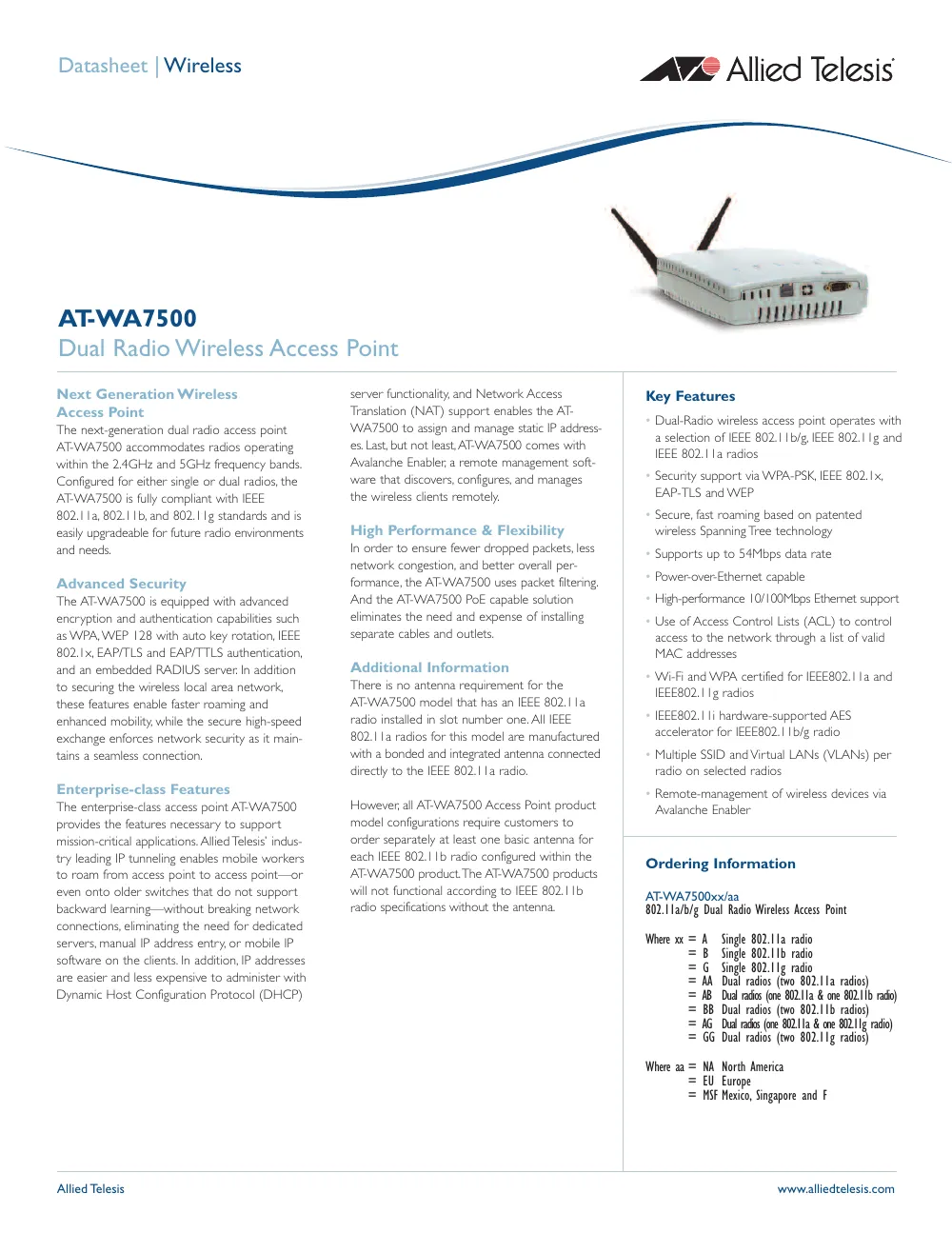
The text of page 1, from the PDF itself
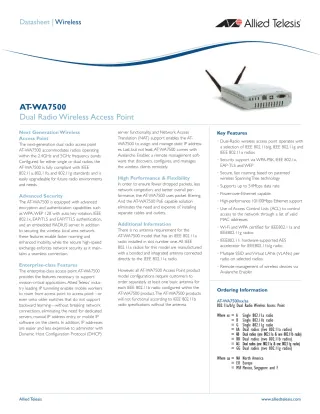
Datasheet | Wireless
AT-WA7500 Dual Radio Wireless Access Point Next Generation Wireless Access Point The next-generation dual radio access point AT-WA7500 accommodates radios operating within the 2.4GHz and 5GHz frequency bands. Configured for either single or dual radios, the AT-WA7500 is fully compliant with IEEE 802.11a, 802.11b, and 802.11g standards and is easily upgradeable for future radio environments and needs.
Advanced Security The AT-WA7500 is equipped with advanced encryption and authentication capabilities such as WPA, WEP 128 with auto key rotation, IEEE 802.1x, EAP/TLS and EAP/TTLS authentication, and an embedded RADIUS server. In addition to securing the wireless local area network, these features enable faster roaming and enhanced mobility, while the secure high-speed exchange enforces network security as it maintains a seamless connection.
server functionality, and Network Access Translation (NAT) support enables the ATWA7500 to assign and manage static IP addresses. Last, but not least, AT-WA7500 comes with Avalanche Enabler, a remote management software that discovers, configures, and manages the wireless clients remotely.
High Performance & Flexibility In order to ensure fewer dropped packets, less network congestion, and better overall performance, the AT-WA7500 uses packet filtering. And the AT-WA7500 PoE capable solution eliminates the need and expense of installing separate cables and outlets.
Additional Information There is no antenna requirement for the AT-WA7500 model that has an IEEE 802.11a radio installed in slot number one. All IEEE 802.11a radios for this model are manufactured with a bonded and integrated antenna connected directly to the IEEE 802.11a radio.
Enterprise-class Features The enterprise-class access point AT-WA7500 provides the features necessary to support mission-critical applications. Allied Telesis’ industry leading IP tunneling enables mobile workers to roam from access point to access point - or even onto older switches that do not support backward learning - without breaking network connections, eliminating the need for dedicated servers, manual IP address entry, or mobile IP software on the clients. In addition, IP addresses are easier and less expensive to administer with Dynamic Host Configuration Protocol (DHCP)
However, all AT-WA7500 Access Point product model configurations require customers to order separately at least one basic antenna for each IEEE 802.11b radio configured within the AT-WA7500 product.The AT-WA7500 products will not functional according to IEEE 802.11b radio specifications without the antenna.
Key Features
- Dual-Radio wireless access point operates with a selection of IEEE 802.11b/g, IEEE 802.11g and IEEE 802.11a radios
- Security support via WPA-PSK, IEEE 802.1x, EAP-TLS and WEP
- Secure, fast roaming based on patented wireless Spanning Tree technology
- Supports up to 54Mbps data rate
- Power-over-Ethernet capable
- High-performance 10/100Mbps Ethernet support
- Use of Access Control Lists (ACL) to control access to the network through a list of valid MAC addresses
- Wi-Fi and WPA certified for IEEE802.11a and IEEE802.11g radios
- IEEE802.11i hardware-supported AES accelerator for IEEE802.11b/g radio
- Multiple SSID and Virtual LANs (VLANs) per radio on selected radios
- Remote-management of wireless devices via Avalanche Enabler
Ordering Information AT-WA7500xx/aa
802.11a/b/g Dual Radio Wireless Access Point Where xx = A Single 802.11a radio = B Single 802.11b radio = G Single 802.11g radio = AA Dual radios (two 802.11a radios) = AB Dual radios (one 802.11a & one 802.11b radio) = BB Dual radios (two 802.11b radios) = AG Dual radios (one 802.11a & one 802.11g radio) = GG Dual radios (two 802.11g radios) Where aa = NA North America = EU Europe = MSF Mexico, Singapore and F
Allied Telesis
www.alliedtelesis.com
Page2of 2
Open in the PDF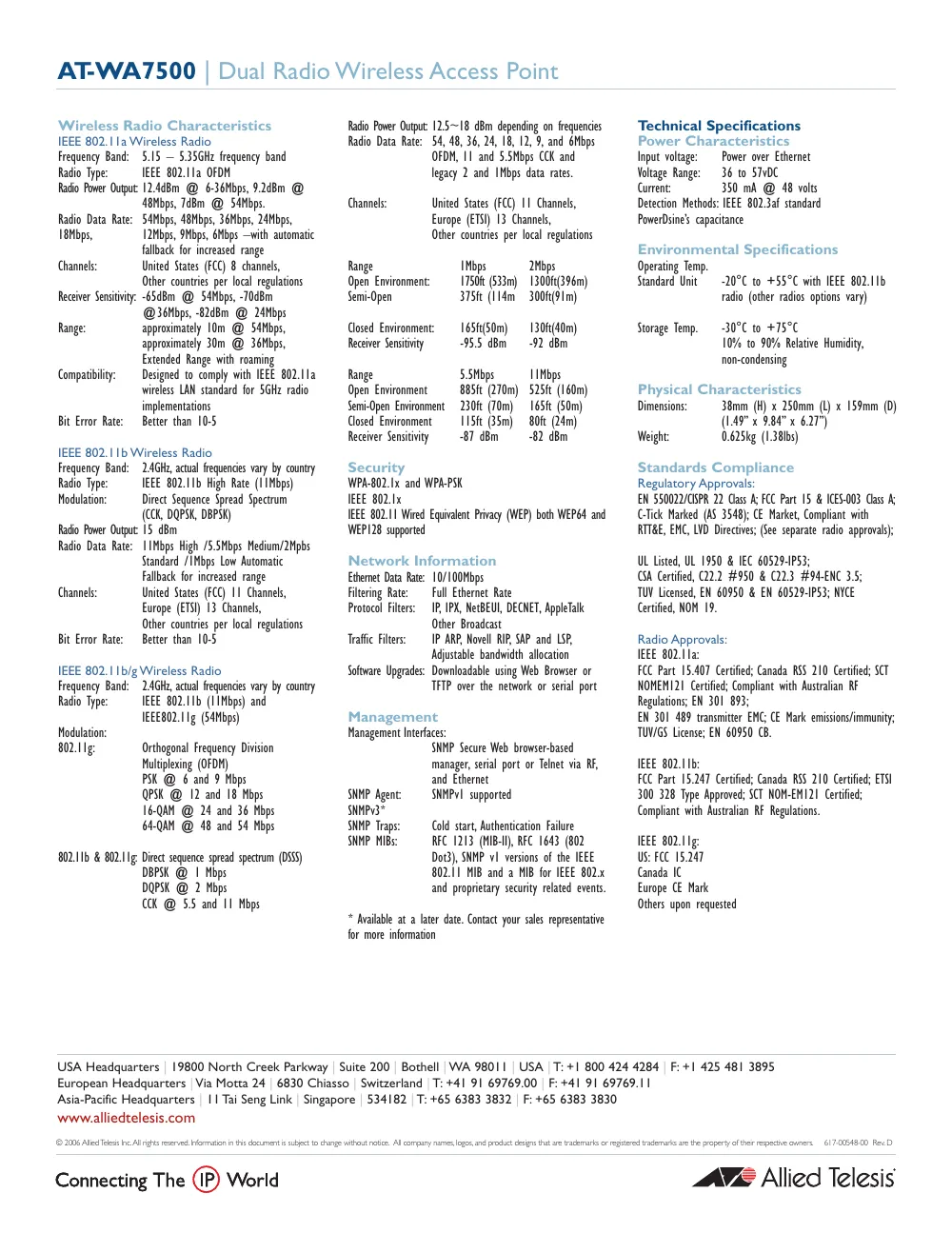
The text of page 2, from the PDF itself
AT-WA7500 | Dual Radio Wireless Access Point Wireless Radio Characteristics IEEE 802.11a Wireless Radio
Frequency Band: 5.15 – 5.35GHz frequency band Radio Type: IEEE 802.11a OFDM Radio Power Output: 12.4dBm @ 6-36Mbps, 9.2dBm @ 48Mbps, 7dBm @ 54Mbps. Radio Data Rate: 54Mbps, 48Mbps, 36Mbps, 24Mbps, 18Mbps, 12Mbps, 9Mbps, 6Mbps –with automatic fallback for increased range Channels: United States (FCC) 8 channels, Other countries per local regulations Receiver Sensitivity: -65dBm @ 54Mbps, -70dBm @36Mbps, -82dBm @ 24Mbps Range: approximately 10m @ 54Mbps, approximately 30m @ 36Mbps, Extended Range with roaming Compatibility: Designed to comply with IEEE 802.11a wireless LAN standard for 5GHz radio implementations Bit Error Rate: Better than 10-5
Radio Power Output: 12.5~18 dBm depending on frequencies Radio Data Rate: 54, 48, 36, 24, 18, 12, 9, and 6Mbps OFDM, 11 and 5.5Mbps CCK and legacy 2 and 1Mbps data rates. Channels:
United States (FCC) 11 Channels, Europe (ETSI) 13 Channels, Other countries per local regulations
Range Open Environment: Semi-Open
1Mbps 2Mbps 1750ft (533m) 1300ft(396m) 375ft (114m 300ft(91m)
Closed Environment: Receiver Sensitivity
165ft(50m) -95.5 dBm
130ft(40m) -92 dBm
Range Open Environment Semi-Open Environment Closed Environment Receiver Sensitivity
5.5Mbps 885ft (270m) 230ft (70m) 115ft (35m) -87 dBm
11Mbps 525ft (160m) 165ft (50m) 80ft (24m) -82 dBm
Technical Specifications Power Characteristics Input voltage: Power over Ethernet Voltage Range: 36 to 57vDC Current: 350 mA @ 48 volts Detection Methods: IEEE 802.3af standard PowerDsine’s capacitance Environmental Specifications Operating Temp. Standard Unit -20°C to +55°C with IEEE 802.11b radio (other radios options vary) Storage Temp.
-30°C to +75°C 10% to 90% Relative Humidity, non-condensing
Physical Characteristics Dimensions: 38mm (H) x 250mm (L) x 159mm (D) (1.49” x 9.84” x 6.27”) Weight: 0.625kg (1.38lbs)
IEEE 802.11b Wireless Radio
Frequency Band: 2.4GHz, actual frequencies vary by country Radio Type: IEEE 802.11b High Rate (11Mbps) Modulation: Direct Sequence Spread Spectrum (CCK, DQPSK, DBPSK) Radio Power Output: 15 dBm Radio Data Rate: 11Mbps High /5.5Mbps Medium/2Mpbs Standard /1Mbps Low Automatic Fallback for increased range Channels: United States (FCC) 11 Channels, Europe (ETSI) 13 Channels, Other countries per local regulations Bit Error Rate: Better than 10-5 IEEE 802.11b/g Wireless Radio
Frequency Band: 2.4GHz, actual frequencies vary by country Radio Type: IEEE 802.11b (11Mbps) and IEEE802.11g (54Mbps) Modulation: 802.11g: Orthogonal Frequency Division Multiplexing (OFDM) PSK @ 6 and 9 Mbps QPSK @ 12 and 18 Mbps 16-QAM @ 24 and 36 Mbps 64-QAM @ 48 and 54 Mbps 802.11b & 802.11g: Direct sequence spread spectrum (DSSS) DBPSK @ 1 Mbps DQPSK @ 2 Mbps CCK @ 5.5 and 11 Mbps
Security WPA-802.1x and WPA-PSK IEEE 802.1x IEEE 802.11 Wired Equivalent Privacy (WEP) both WEP64 and WEP128 supported
Standards Compliance
Network Information Ethernet Data Rate: 10/100Mbps Filtering Rate: Full Ethernet Rate Protocol Filters: IP, IPX, NetBEUI, DECNET, AppleTalk Other Broadcast Traffic Filters: IP ARP, Novell RIP, SAP and LSP, Adjustable bandwidth allocation Software Upgrades: Downloadable using Web Browser or TFTP over the network or serial port
UL Listed, UL 1950 & IEC 60529-IP53; CSA Certified, C22.2 #950 & C22.3 #94-ENC 3.5; TUV Licensed, EN 60950 & EN 60529-IP53; NYCE Certified, NOM 19.
Management Management Interfaces: SNMP Secure Web browser-based manager, serial port or Telnet via RF, and Ethernet SNMP Agent: SNMPv1 supported SNMPv3* SNMP Traps: Cold start, Authentication Failure SNMP MIBs: RFC 1213 (MIB-II), RFC 1643 (802 Dot3), SNMP v1 versions of the IEEE 802.11 MIB and a MIB for IEEE 802.x and proprietary security related events.
- Regulatory Approvals
- EN 550022/CISPR 22 Class A; FCC Part 15 & ICES-003 Class A; C-Tick Marked (AS 3548); CE Market, Compliant with RTT&E, EMC, LVD Directives; (See separate radio approvals);
- Radio Approvals
- IEEE 802.11a: FCC Part 15.407 Certified; Canada RSS 210 Certified; SCT NOMEM121 Certified; Compliant with Australian RF Regulations; EN 301 893; EN 301 489 transmitter EMC; CE Mark emissions/immunity; TUV/GS License; EN 60950 CB. IEEE 802.11b: FCC Part 15.247 Certified; Canada RSS 210 Certified; ETSI 300 328 Type Approved; SCT NOM-EM121 Certified; Compliant with Australian RF Regulations. IEEE 802.11g: US: FCC 15.247 Canada IC Europe CE Mark Others upon requested
- Available at a later date. Contact your sales representative for more information
USA Headquarters | 19800 North Creek Parkway | Suite 200 | Bothell | WA 98011 | USA | T: +1 800 424 4284 | F: +1 425 481 3895 European Headquarters | Via Motta 24 | 6830 Chiasso | Switzerland | T: +41 91 69769.00 | F: +41 91 69769.11 Asia-Pacific Headquarters | 11 Tai Seng Link | Singapore | 534182 | T: +65 6383 3832 | F: +65 6383 3830
www.alliedtelesis.com © 2006 Allied Telesis Inc. All rights reserved. Information in this document is subject to change without notice. All company names, logos, and product designs that are trademarks or registered trademarks are the property of their respective owners.
617-00548-00 Rev. D