


Spec sheet · Datalogic
Datalogic OLV-10 and PSC OLV-10 Spec Sheet
Spec sheet2 pagesPDF 383 KB
Both pages are below, each with its text.
Covers · 2 models
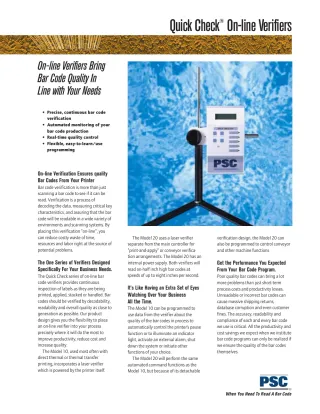
The models it covers
From the sheet · read page by page
Key facts from this sheet
Each line names its page in the PDF.
Two-page data sheet for the PSC Quick Check On-line Verifiers, the Model 10 (QCOLV10) and Model 20 (QCOLV20), which check bar code quality while labels are printed or handled. It describes both models and lists the verification specifications, inputs and outputs, temperature ratings, and part numbers of cables, printer kits and accessories.
- Device
- On-line bar code verifier that inspects labels continuously as they are printed, applied, stacked or handled p. 1
- Model 10 setup
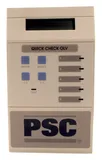
- Model 10: laser verifier powered by the printer, used most often with direct thermal or thermal transfer printing p. 1
- Symbologies
- Code 39, Interleaved 2 of 5, UPC/EAN with addendum, Codabar, Code 128, Code 93 p. 2
- Verification methods
- Traditional (except print contrast signal); ANSI/CEN (decode and decodability only) p. 2
- Scanner
- Moving beam at 670 nm, 40 scans/second nominal p. 2
- Reading speed
- Half-inch high bar codes at up to 8 inches per second p. 1
- Model 20 setup
- Model 20: laser verifier separate from the controller, internal power supply, for print-and-apply or conveyor use p. 1
- Minimum X dimension
- 7.5 mil (0.19 mm) p. 2
- Communication and outputs
- RS-232; open collector outputs, 250 mA sink max, 24 VDC pull-up max p. 2
- Temperature
- Operating 32 to 122°F (0 to 50°C); storage -40 to 158°F (-40 to 70°C) p. 2
- Part numbers
- QCOLV10 (Model 10), QCOLV20 (Model 20) p. 2
- Interface cables
- QCOLVC10U unterminated cable (Model 10), QCOLVC20U unterminated cable (Model 20), QCOLVCRS232 RS-232 communication cable p. 2
- Printer cables and kits
- QCOLVC004 Sato 8400, QCOLVC004A Sato 8400 with rewinder, QCOLVC005A and QCOLVC005B Zebra 140, QCOLVC007 Prodigy, QCOLVC009 Zebra 105S/105SE; kits QCOLV1009, QCOLV1010, QCOLV1011 for Zebra Xi and Xi11 printers p. 2
- Accessories
- QCOLVPS external power supply, QCOMOLV operators manual, QCOLVSTD Model 10 metal stand p. 2
What this sheet walks you through
- Choosing between the printer-powered Model 10 and the separate-scanner Model 20 p. 1
- Programmable responses to verification results, such as No Read, Warnings and Rejects p. 2
- Switch inputs and electrically isolated inputs p. 2
- Interface cables and printer kits for Sato and Zebra printers p. 2
Good to know
- ANSI/CEN verification covers decode and decodability only; traditional verification leaves out print contrast signal. p. 2
- Specifications are subject to change without notice. p. 2
Questions this sheet answers
What is the difference between the Quick Check OLV Model 10 and Model 20?
The Model 10 is a single housing powered by the printer; the Model 20 has a separate scanner and controller with an internal power supply and can also control conveyors. p. 1
What bar codes can the Quick Check OLV-10 verify?
Code 39, Interleaved 2 of 5, UPC/EAN with addendum, Codabar, Code 128 and Code 93. p. 2
Can the on-line verifier stop the printer on a bad bar code?
Yes. The Model 10 can be programmed to control the printer's pause function, light an indicator, set off an external alarm or shut down the system. p. 1
Which labeling standards does the Quick Check on-line verifier support?
AIAG-B1, AIAG-B3/B4/B5, LOGMARS and UCC/EAN/ITF applications. p. 2
The file
Size and text
Every page · 2
Read it here
Each page as it is printed, and its words beside it, so a phone can search and copy them.
Page1of 2
Open in the PDF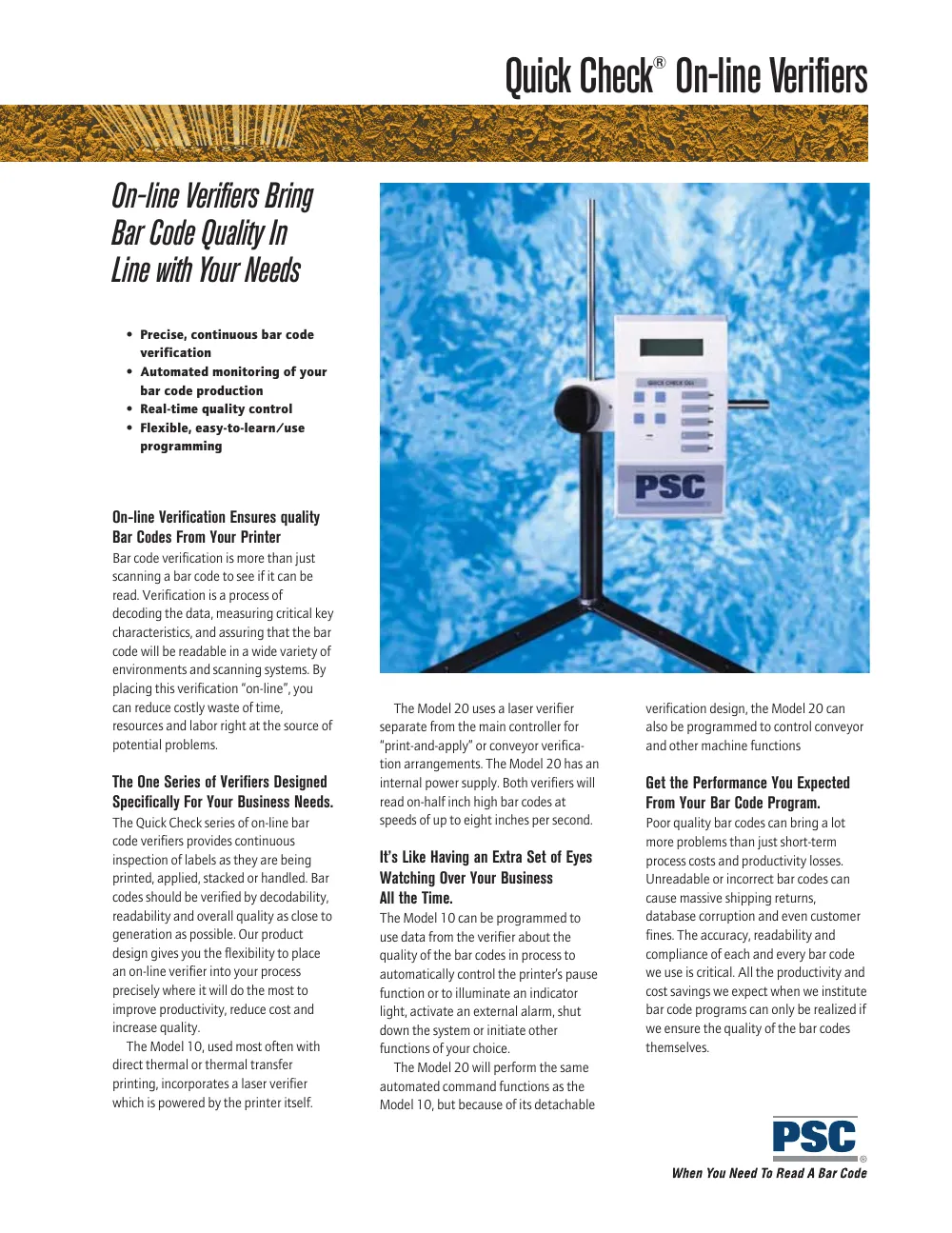
The text of page 1, from the PDF itself
Quick Check On-line Verifiers On-line Verifiers Bring Bar Code Quality In Line with Your Needs
- Precise, continuous bar code verification
- Automated monitoring of your bar code production
- Real-time quality control
- Flexible, easy-to-learn/use programming
On-line Verification Ensures quality Bar Codes From Your Printer Bar code verification is more than just scanning a bar code to see if it can be read. Verification is a process of decoding the data, measuring critical key characteristics, and assuring that the bar code will be readable in a wide variety of environments and scanning systems. By placing this verification “on-line”, you can reduce costly waste of time, resources and labor right at the source of potential problems.
The One Series of Verifiers Designed Specifically For Your Business Needs. The Quick Check series of on-line bar code verifiers provides continuous inspection of labels as they are being printed, applied, stacked or handled. Bar codes should be verified by decodability, readability and overall quality as close to generation as possible. Our product design gives you the flexibility to place an on-line verifier into your process precisely where it will do the most to improve productivity, reduce cost and increase quality. The Model 10, used most often with direct thermal or thermal transfer printing, incorporates a laser verifier which is powered by the printer itself.
The Model 20 uses a laser verifier separate from the main controller for “print-and-apply” or conveyor verification arrangements. The Model 20 has an internal power supply. Both verifiers will read on-half inch high bar codes at speeds of up to eight inches per second.
It’s Like Having an Extra Set of Eyes Watching Over Your Business All the Time. The Model 10 can be programmed to use data from the verifier about the quality of the bar codes in process to automatically control the printer’s pause function or to illuminate an indicator light, activate an external alarm, shut down the system or initiate other functions of your choice. The Model 20 will perform the same automated command functions as the Model 10, but because of its detachable
verification design, the Model 20 can also be programmed to control conveyor and other machine functions
Get the Performance You Expected From Your Bar Code Program. Poor quality bar codes can bring a lot more problems than just short-term process costs and productivity losses. Unreadable or incorrect bar codes can cause massive shipping returns, database corruption and even customer fines. The accuracy, readability and compliance of each and every bar code we use is critical. All the productivity and cost savings we expect when we institute bar code programs can only be realized if we ensure the quality of the bar codes themselves.
Page2of 2
Open in the PDF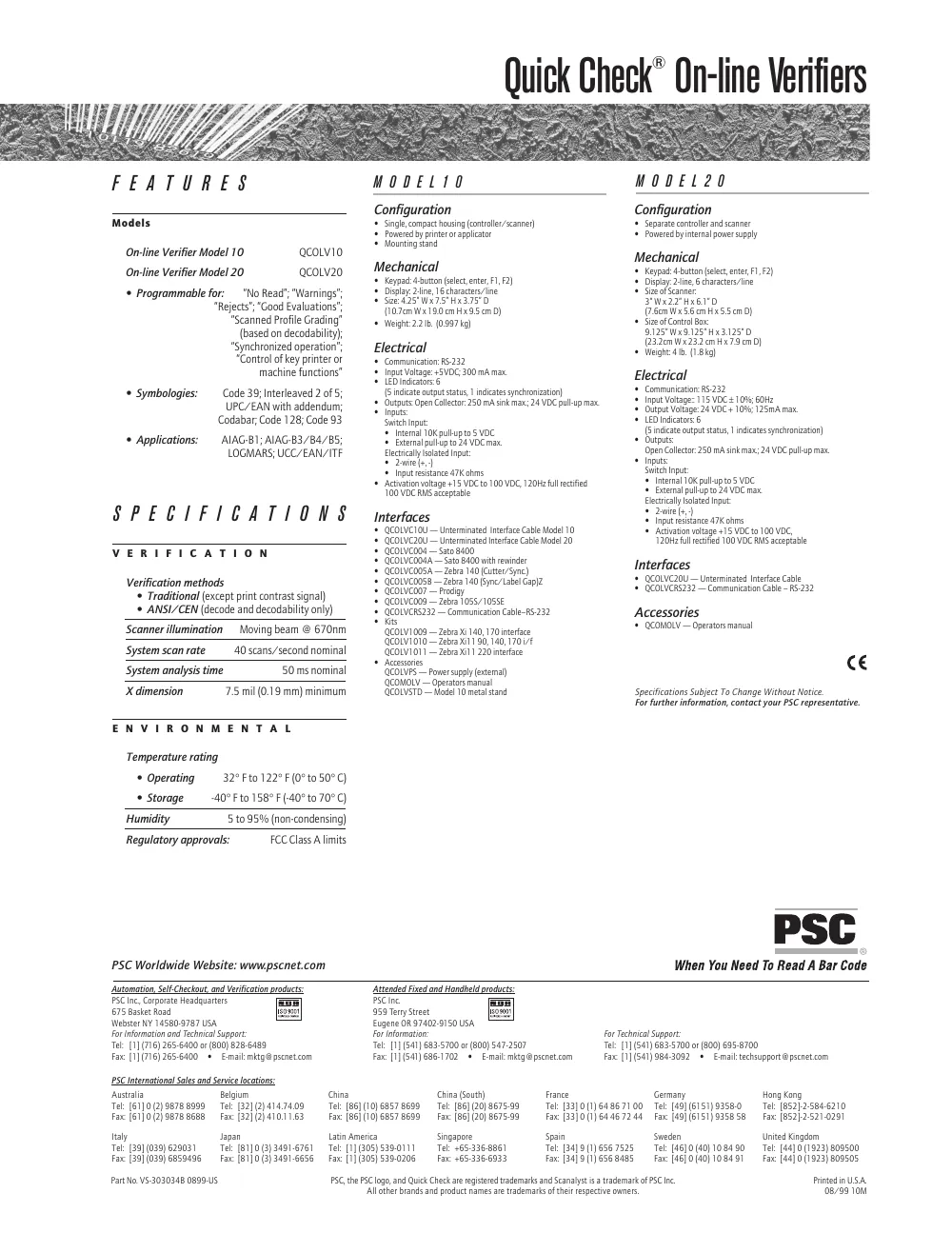
The text of page 2, from the PDF itself
Quick Check On-line Verifiers F E A T U R E S Models
On-line Verifier Model 10
QCOLV10
On-line Verifier Model 20
QCOLV20
- Programmable for: “No Read”; “Warnings”; “Rejects”; “Good Evaluations”; “Scanned Profile Grading” (based on decodability); “Synchronized operation”; “Control of key printer or machine functions”
- Symbologies:
Code 39; Interleaved 2 of 5; UPC/EAN with addendum; Codabar; Code 128; Code 93
- • Applications
- AIAG-B1; AIAG-B3/B4/B5; LOGMARS; UCC/EAN/ITF
S P E C I F I C A T I O N S V E R I F I C A T I O N
Verification methods
- Traditional (except print contrast signal)
- ANSI/CEN (decode and decodability only) Scanner illumination
Moving beam @ 670nm
System scan rate
40 scans/second nominal
System analysis time X dimension
50 ms nominal 7.5 mil (0.19 mm) minimum
M O D E L 1 0M O D E L 2 0ConfigurationConfiguration
- Single, compact housing (controller/scanner)
- Powered by printer or applicator
- Mounting stand
- Separate controller and scanner
- Powered by internal power supply
Mechanical
Mechanical
- Keypad: 4-button (select, enter, F1, F2)
- Display: 2-line, 6 characters/line
- Size of Scanner: 3” W x 2.2” H x 6.1” D (7.6cm W x 5.6 cm H x 5.5 cm D)
- Size of Control Box: 9.125” W x 9.125” H x 3.125” D (23.2cm W x 23.2 cm H x 7.9 cm D)
- Weight: 4 lb. (1.8 kg)
- Keypad: 4-button (select, enter, F1, F2)
- Display: 2-line, 16 characters/line
- Size: 4.25” W x 7.5” H x 3.75” D (10.7cm W x 19.0 cm H x 9.5 cm D)
- Weight: 2.2 lb. (0.997 kg)
Electrical
- Communication: RS-232
- Input Voltage: +5VDC; 300 mA max.
- LED Indicators: 6 (5 indicate output status, 1 indicates synchronization)
- Outputs: Open Collector: 250 mA sink max.; 24 VDC pull-up max.
- Inputs: Switch Input:
- Internal 10K pull-up to 5 VDC
- External pull-up to 24 VDC max. Electrically Isolated Input:
- 2-wire (+, -)
- Input resistance 47K ohms
- Activation voltage +15 VDC to 100 VDC, 120Hz full rectified 100 VDC RMS acceptable
Electrical
- Communication: RS-232
- Input Voltage:: 115 VDC ± 10%; 60Hz
- Output Voltage: 24 VDC + 10%; 125mA max.
- LED Indicators: 6 (5 indicate output status, 1 indicates synchronization)
- Outputs: Open Collector: 250 mA sink max.; 24 VDC pull-up max.
- Inputs: Switch Input:
- Internal 10K pull-up to 5 VDC
- External pull-up to 24 VDC max. Electrically Isolated Input:
- 2-wire (+, -)
- Input resistance 47K ohms
- Activation voltage +15 VDC to 100 VDC, 120Hz full rectified 100 VDC RMS acceptable
Interfaces
- QCOLVC10U, Unterminated Interface Cable Model 10
- QCOLVC20U, Unterminated Interface Cable Model 20
- QCOLVC004, Sato 8400
- QCOLVC004A, Sato 8400 with rewinder
- QCOLVC005A, Zebra 140 (Cutter/Sync.)
- QCOLVC005B, Zebra 140 (Sync/Label Gap)Z
- QCOLVC007, Prodigy
- QCOLVC009, Zebra 105S/105SE
- QCOLVCRS232, Communication Cable–RS-232
- Kits QCOLV1009, Zebra Xi 140, 170 interface QCOLV1010, Zebra Xi11 90, 140, 170 i/f QCOLV1011, Zebra Xi11 220 interface
- Accessories QCOLVPS, Power supply (external) QCOMOLV, Operators manual QCOLVSTD, Model 10 metal stand
Interfaces
- QCOLVC20U, Unterminated Interface Cable
- QCOLVCRS232, Communication Cable – RS-232
Accessories
- QCOMOLV, Operators manual
Specifications Subject To Change Without Notice. For further information, contact your PSC representative.
E N V I R O N M E N T A L
Temperature rating
- Operating
32° F to 122° F (0° to 50° C)
- Storage
-40° F to 158° F (-40° to 70° C)
Humidity
5 to 95% (non-condensing)
- Regulatory approvals
- FCC Class A limits
PSC Worldwide Website: www.pscnet.com Automation, Self-Checkout, and Verification products: PSC Inc., Corporate Headquarters 675 Basket Road Webster NY 14580-9787 USA For Information and Technical Support: Tel: [1] (716) 265-6400 or (800) 828-6489 Fax: [1] (716) 265-6400 • E-mail: mktg@pscnet.com
Attended Fixed and Handheld products: PSC Inc. 959 Terry Street Eugene OR 97402-9150 USA For Information: Tel: [1] (541) 683-5700 or (800) 547-2507 Fax: [1] (541) 686-1702 • E-mail: mktg@pscnet.com
For Technical Support: Tel: [1] (541) 683-5700 or (800) 695-8700 Fax: [1] (541) 984-3092 • E-mail: techsupport@pscnet.com
PSC International Sales and Service locations: Australia Belgium Tel: [61] 0 (2) 9878 8999 Tel: [32] (2) 414.74.09 Fax: [61] 0 (2) 9878 8688 Fax: [32] (2) 410.11.63
China Tel: [86] (10) 6857 8699 Fax: [86] (10) 6857 8699
China (South) Tel: [86] (20) 8675-99 Fax: [86] (20) 8675-99
France Tel: [33] 0 (1) 64 86 71 00 Fax: [33] 0 (1) 64 46 72 44
Germany Tel: [49] (6151) 9358-0 Fax: [49] (6151) 9358 58
Hong Kong Tel: [852]-2-584-6210 Fax: [852]-2-521-0291
Italy Tel: [39] (039) 629031 Fax: [39] (039) 6859496
Latin America Tel: [1] (305) 539-0111 Fax: [1] (305) 539-0206
Singapore Tel: +65-336-8861 Fax: +65-336-6933
Spain Tel: [34] 9 (1) 656 7525 Fax: [34] 9 (1) 656 8485
Sweden Tel: [46] 0 (40) 10 84 90 Fax: [46] 0 (40) 10 84 91
United Kingdom Tel: [44] 0 (1923) 809500 Fax: [44] 0 (1923) 809505
Part No. VS-303034B 0899-US
Japan Tel: [81] 0 (3) 3491-6761 Fax: [81] 0 (3) 3491-6656
PSC, the PSC logo, and Quick Check are registered trademarks and Scanalyst is a trademark of PSC Inc. All other brands and product names are trademarks of their respective owners.
Printed in U.S.A. 08/99 10M