


Spec sheet · Linx
Linx VII-5 Spec Sheet
Spec sheet2 pagesPDF 121 KB
Both pages are below, each with its text.
Covers · 1 model
The models it covers
From the sheet · read page by page
Key facts from this sheet
Each line names its page in the PDF.
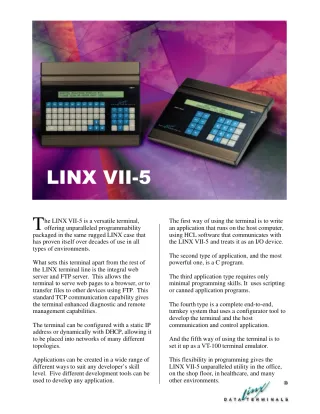
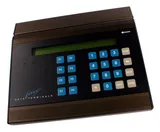
Two-page spec sheet (Rev 09/2011) for the LINX VII-5 data collection terminal from LINX Data Terminals. It describes the built-in web and FTP servers, the hardware and keypad options, and the five ways to program the terminal, from host-driven control to VT100 emulation.
- Device
- Rugged programmable data collection terminal with integral web server and FTP server p. 1
- Network
- 10/100 Mbit Ethernet; static IP address or DHCP p. 1, 2
- Serial ports
- 2 full RS232 serial ports p. 2
- Memory
- 16MB SDRAM main memory; 2MB flash program storage; 0.5MB battery-backed SRAM p. 2
- Display
- 2x40 backlit supertwist liquid crystal display, 5x7 dot matrix; optional extended temperature range (-4F to 140F) p. 2
- Keypad
- Sealed polyester with tactile feedback: 24 key numeric with 8 F-keys or 63 key alphanumeric with 10 F-keys p. 2
- Digital I/O
- 3 opto-isolated digital inputs, 1 relay control line, 3 TTL digital outputs p. 2
- Reader options
- Integral mag stripe slot reader; integral slot reader for linear bar codes, visible light or IR p. 2
- Other hardware
- Real-time clock; Mylar speaker for audio tones p. 2
- Programming modes
- Host Control Mode (HCL) and Automator; Native C programs; LINXScript, SPI and ITAS; Turnkey wizard system; VT100 Telnet emulation p. 2
What this sheet walks you through
- Choosing one of the five application development methods p. 1, 2
- Writing native C programs that run on the terminal p. 2
- Setting up time and attendance with table-driven ITAS p. 2
- Using the terminal as a VT100 Telnet terminal p. 2
Questions this sheet answers
How is the LINX VII-5 programmed?
Five ways: a host program using HCL, a native C program, scripting (LINXScript, SPI or ITAS), the Turnkey wizard system, or VT100 terminal emulation. p. 1
Does the LINX VII-5 have Ethernet?
Yes, a 10/100 Mbit Ethernet interface, with a static IP address or DHCP. p. 2
What keypads are available for the LINX VII-5?
A 24 key numeric keypad with 8 F-keys or a 63 key alphanumeric keypad with 10 F-keys. p. 2
What tools are needed for LINXScript or SPI programs?
Only an FTP client and a text editor. p. 2
The file
Size and text
Every page · 2
Read it here
Each page as it is printed, and its words beside it, so a phone can search and copy them.
Page1of 2
Open in the PDF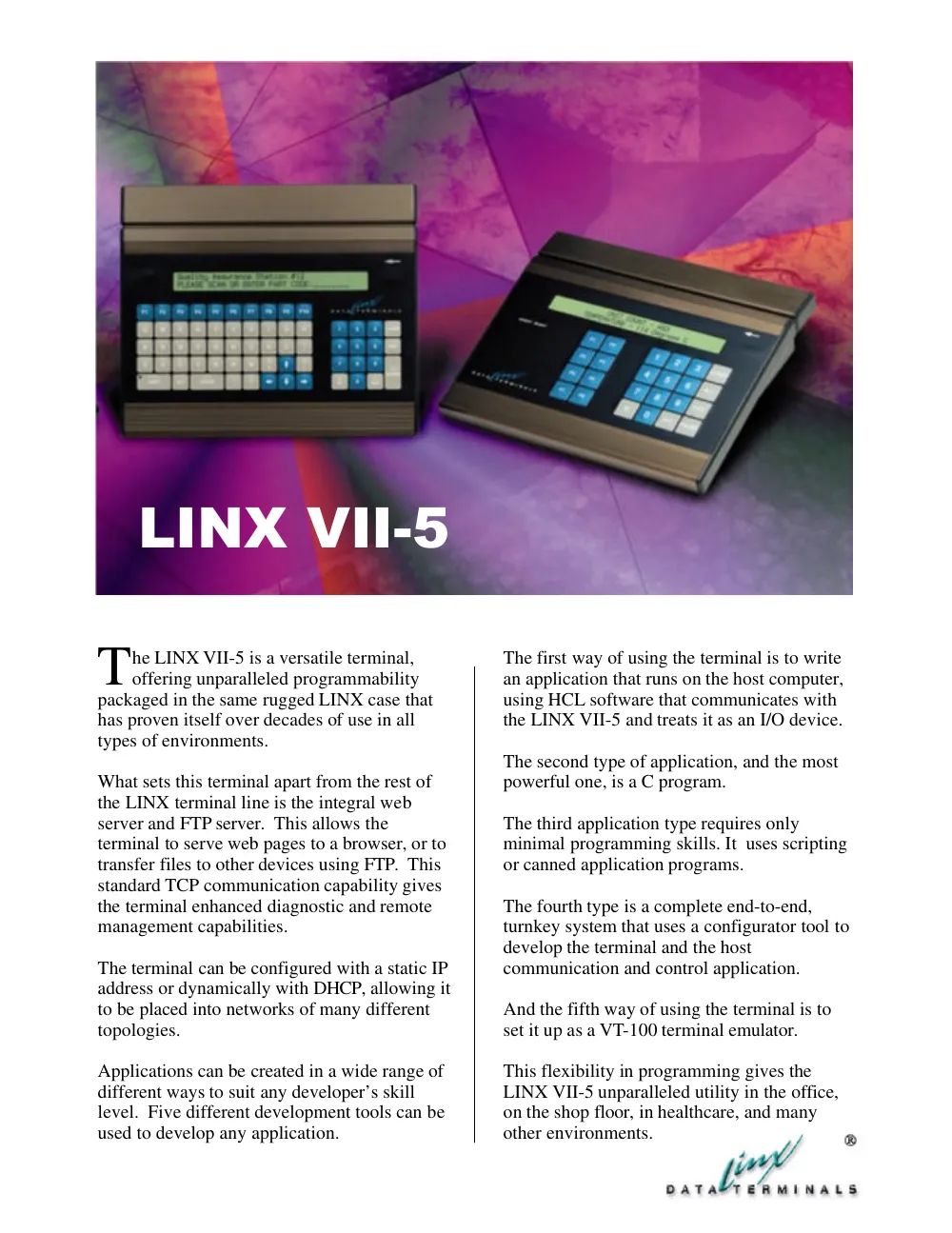
The text of page 1, from the PDF itself
LINX VII-5 T
he LINX VII-5 is a versatile terminal, offering unparalleled programmability packaged in the same rugged LINX case that has proven itself over decades of use in all types of environments. What sets this terminal apart from the rest of the LINX terminal line is the integral web server and FTP server. This allows the terminal to serve web pages to a browser, or to transfer files to other devices using FTP. This standard TCP communication capability gives the terminal enhanced diagnostic and remote management capabilities. The terminal can be configured with a static IP address or dynamically with DHCP, allowing it to be placed into networks of many different topologies. Applications can be created in a wide range of different ways to suit any developer’s skill level. Five different development tools can be used to develop any application.
The first way of using the terminal is to write an application that runs on the host computer, using HCL software that communicates with the LINX VII-5 and treats it as an I/O device. The second type of application, and the most powerful one, is a C program. The third application type requires only minimal programming skills. It uses scripting or canned application programs. The fourth type is a complete end-to-end, turnkey system that uses a configurator tool to develop the terminal and the host communication and control application. And the fifth way of using the terminal is to set it up as a VT-100 terminal emulator. This flexibility in programming gives the LINX VII-5 unparalleled utility in the office, on the shop floor, in healthcare, and many other environments.
Page2of 2
Open in the PDF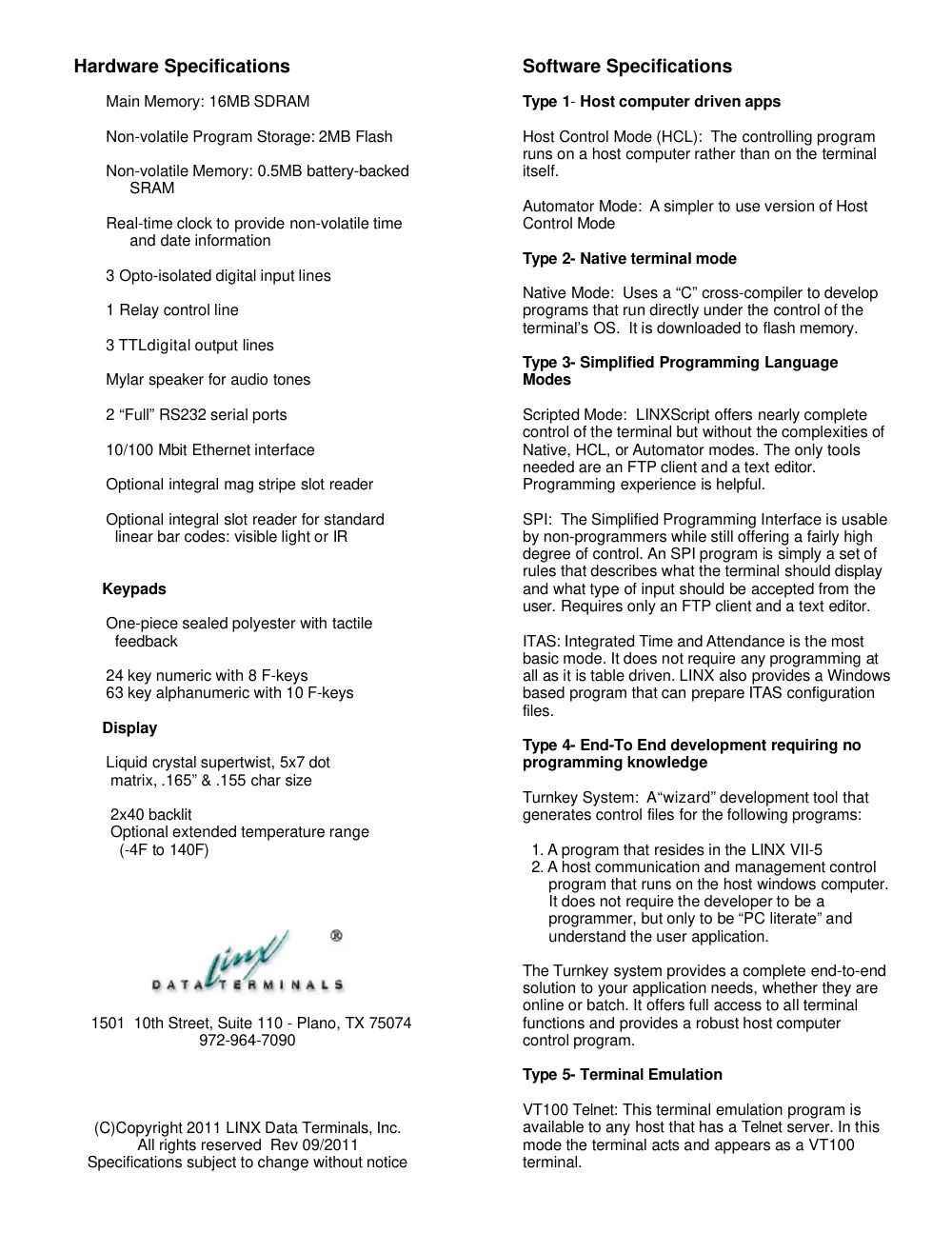
The text of page 2, from the PDF itself
Hardware Specifications
Software Specifications
Main Memory: 16MB SDRAM
Type 1- Host computer driven apps
Non-volatile Program Storage: 2MB Flash
Host Control Mode (HCL): The controlling program runs on a host computer rather than on the terminal itself.
Non-volatile Memory: 0.5MB battery-backed SRAM Real-time clock to provide non-volatile time and date information
Automator Mode: A simpler to use version of Host Control Mode Type 2- Native terminal mode
3 Opto-isolated digital input lines 1 Relay control line
Native Mode: Uses a “C” cross-compiler to develop programs that run directly under the control of the terminal’s OS. It is downloaded to flash memory.
3 TTLdigital output lines Mylar speaker for audio tones 2 “Full” RS232 serial ports 10/100 Mbit Ethernet interface Optional integral mag stripe slot reader Optional integral slot reader for standard linear bar codes: visible light or IR Keypads One-piece sealed polyester with tactile feedback 24 key numeric with 8 F-keys 63 key alphanumeric with 10 F-keys
Type 3- Simplified Programming Language Modes Scripted Mode: LINXScript offers nearly complete control of the terminal but without the complexities of Native, HCL, or Automator modes. The only tools needed are an FTP client and a text editor. Programming experience is helpful. SPI: The Simplified Programming Interface is usable by non-programmers while still offering a fairly high degree of control. An SPI program is simply a set of rules that describes what the terminal should display and what type of input should be accepted from the user. Requires only an FTP client and a text editor. ITAS: Integrated Time and Attendance is the most basic mode. It does not require any programming at all as it is table driven. LINX also provides a Windows based program that can prepare ITAS configuration files.
Display Liquid crystal supertwist, 5x7 dot matrix, .165” & .155 char size 2x40 backlit Optional extended temperature range (-4F to 140F)
1501 10th Street, Suite 110 - Plano, TX 75074 972-964-7090
Type 4- End-To End development requiring no programming knowledge Turnkey System: A“wizard” development tool that generates control files for the following programs: 1. A program that resides in the LINX VII-5 2. A host communication and management control program that runs on the host windows computer. It does not require the developer to be a programmer, but only to be “PC literate” and understand the user application. The Turnkey system provides a complete end-to-end solution to your application needs, whether they are online or batch. It offers full access to all terminal functions and provides a robust host computer control program. Type 5- Terminal Emulation
(C)Copyright 2011 LINX Data Terminals, Inc. All rights reserved Rev 09/2011 Specifications subject to change without notice
VT100 Telnet: This terminal emulation program is available to any host that has a Telnet server. In this mode the terminal acts and appears as a VT100 terminal.