


Spec sheet · Linx
Linx VII-3 Spec Sheet
Spec sheet2 pagesPDF 2.3 MB
Both pages are below, each with its text.
Covers · 1 model
The models it covers
From the sheet · read page by page
Key facts from this sheet
Each line names its page in the PDF.
This two-page spec sheet describes the LINX VII-3, an Ethernet data collection terminal from LINX Data Terminals for time, access control and production tracking work. It lists memory, I/O, reader options, display, power and the LINXScript-3 programming language and communication modes.
- Device
- Industrial data collection terminal in a black ABS plastic case p. 1
- Network
- 10/100 full duplex Ethernet, TCP/IP, DNS, DHCP or static IP p. 1, 2
- Serial port
- One full RS232 port, up to 115KB p. 2
- Memory
- 8MB SDRAM, 4MB flash, 256KB battery-backed SRAM p. 2
- Digital I/O
- 1 opto-isolated input, 2 TTL outputs p. 2
- Reader options
- Fingerprint (9,000 templates), bar code slot, three-track mag stripe, RFID proximity; laser/wand port p. 2
- Display
- Blue-white graphic LCD, 128x64, international character set p. 2
- Power
- 100-240V, 47-63Hz; Power Over Ethernet optional p. 2
- Size
- H 2.25 in x W 7 in x L 9.5 in (5.7 x 17.8 x 24.1 cm) p. 2
- Keypad
- One-piece sealed polyester with tactile feedback p. 2
- Programming
- LINXScript-3, written as a text file and downloaded by FTP p. 2
- Communication modes
- HTTP data posting, LINX Evolution, FTP p. 2
- Built-in servers
- Web server for setup and diagnostics, plus an FTP server p. 1
What this sheet walks you through
- Writing and downloading LINXScript-3 programs p. 2
- Posting data to a web server over HTTP p. 1, 2
- Setting up the terminal from a browser or its own menus p. 1
Questions this sheet answers
Can the LINX VII-3 be powered over Ethernet?
Yes, Power Over Ethernet is an option; otherwise it runs on 100-240V, 47-63Hz. p. 2
How many fingerprints does the LINX VII-3 reader hold?
The optional fingerprint reader has a 9,000 template capacity. p. 2
How do you program the LINX VII-3?
In LINXScript-3: write the program as an ASCII text file and send it to the terminal with an FTP client. p. 2
Does the LINX VII-3 support DHCP?
Yes, it can use a static IP address or get one by DHCP. p. 1
The file
Size and text
Every page · 2
Read it here
Each page as it is printed, and its words beside it, so a phone can search and copy them.
Page1of 2
Open in the PDF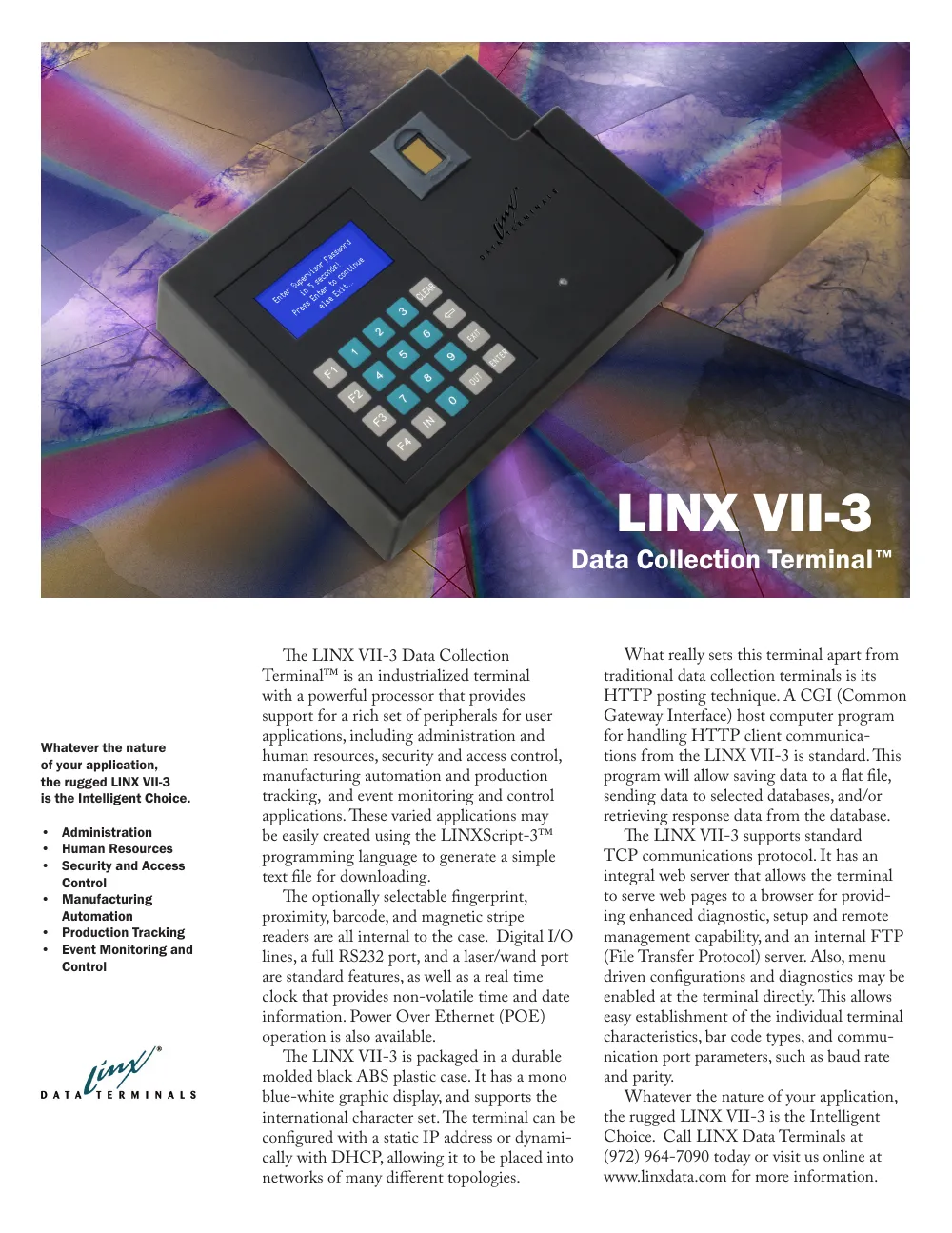
The text of page 1, from the PDF itself
LINX VII-3
Data Collection Terminal ™
Whatever the nature of your application, the rugged LINX VII-3 is the Intelligent Choice.
Administration Human Resources Security and Access Control Manufacturing Automation Production Tracking Event Monitoring and Control
The LINX VII-3 Data Collection Terminal™ is an industrialized terminal with a powerful processor that provides support for a rich set of peripherals for user applications, including administration and human resources, security and access control, manufacturing automation and production tracking, and event monitoring and control applications. These varied applications may be easily created using the LINXScript-3™ programming language to generate a simple text file for downloading. The optionally selectable fingerprint, proximity, barcode, and magnetic stripe readers are all internal to the case. Digital I/O lines, a full RS232 port, and a laser/wand port are standard features, as well as a real time clock that provides non-volatile time and date information. Power Over Ethernet (POE) operation is also available. The LINX VII-3 is packaged in a durable molded black ABS plastic case. It has a mono blue-white graphic display, and supports the international character set. The terminal can be configured with a static IP address or dynamically with DHCP, allowing it to be placed into networks of many different topologies.
What really sets this terminal apart from traditional data collection terminals is its HTTP posting technique. A CGI (Common Gateway Interface) host computer program for handling HTTP client communications from the LINX VII-3 is standard. This program will allow saving data to a flat file, sending data to selected databases, and/or retrieving response data from the database. The LINX VII-3 supports standard TCP communications protocol. It has an integral web server that allows the terminal to serve web pages to a browser for providing enhanced diagnostic, setup and remote management capability, and an internal FTP (File Transfer Protocol) server. Also, menu driven configurations and diagnostics may be enabled at the terminal directly. This allows easy establishment of the individual terminal characteristics, bar code types, and communication port parameters, such as baud rate and parity. Whatever the nature of your application, the rugged LINX VII-3 is the Intelligent Choice. Call LINX Data Terminals at (972) 964-7090 today or visit us online at www.linxdata.com for more information.
Page2of 2
Open in the PDF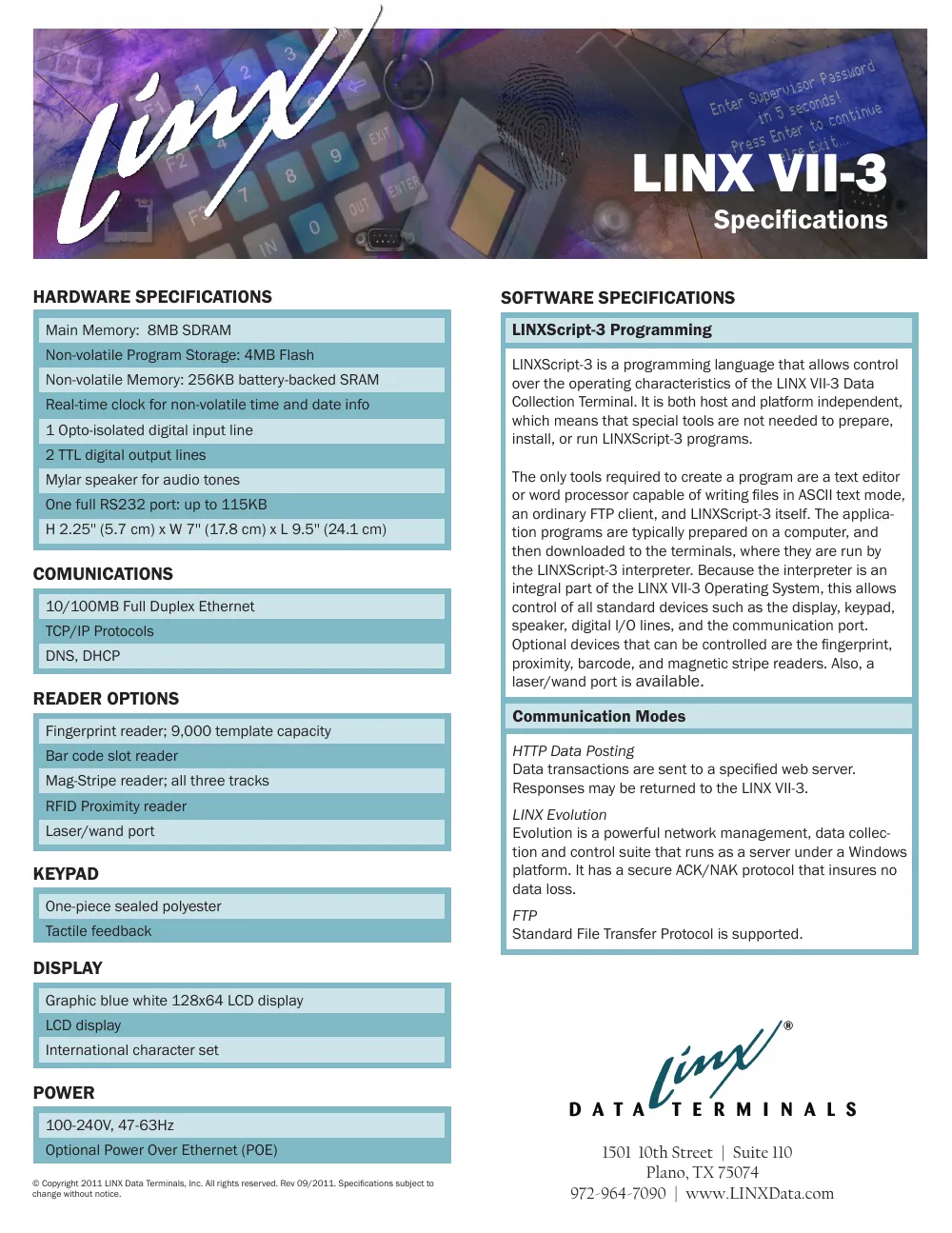
The text of page 2, from the PDF itself
LINX VII-3
Specifications
HARDWARE SPECIFICATIONS Main Memory: 8MB SDRAM Non-volatile Program Storage: 4MB Flash Non-volatile Memory: 256KB battery-backed SRAM Real-time clock for non-volatile time and date info 1 Opto-isolated digital input line 2 TTL digital output lines Mylar speaker for audio tones One full RS232 port: up to 115KB H 2.25'' (5.7 cm) x W 7'' (17.8 cm) x L 9.5'' (24.1 cm)
COMUNICATIONS 10/100MB Full Duplex Ethernet TCP/IP Protocols DNS, DHCP
READER OPTIONS Fingerprint reader; 9,000 template capacity Bar code slot reader Mag-Stripe reader; all three tracks RFID Proximity reader Laser/wand port
KEYPAD One-piece sealed polyester Tactile feedback
SOFTWARE SPECIFICATIONS LINXScript-3 Programming LINXScript-3 is a programming language that allows control over the operating characteristics of the LINX VII-3 Data Collection Terminal. It is both host and platform independent, which means that special tools are not needed to prepare, install, or run LINXScript-3 programs. The only tools required to create a program are a text editor or word processor capable of writing files in ASCII text mode, an ordinary FTP client, and LINXScript-3 itself. The application programs are typically prepared on a computer, and then downloaded to the terminals, where they are run by the LINXScript-3 interpreter. Because the interpreter is an integral part of the LINX VII-3 Operating System, this allows control of all standard devices such as the display, keypad, speaker, digital I/O lines, and the communication port. Optional devices that can be controlled are the fingerprint, proximity, barcode, and magnetic stripe readers. Also, a laser/wand port is available.
Communication Modes HTTP Data Posting Data transactions are sent to a specified web server. Responses may be returned to the LINX VII-3. LINX Evolution Evolution is a powerful network management, data collection and control suite that runs as a server under a Windows platform. It has a secure ACK/NAK protocol that insures no data loss. FTP Standard File Transfer Protocol is supported.
DISPLAY Graphic blue white 128x64 LCD display LCD display International character set
POWER 100-240V, 47-63Hz Optional Power Over Ethernet (POE) © Copyright 2011 LINX Data Terminals, Inc. All rights reserved. Rev 09/2011. Specifications subject to change without notice.
1501 10th Street | Suite 110 Plano, TX 75074 972-964-7090 | www.LINXData.com