


Spec sheet · Cisco
Cisco FastHub 100 Spec Sheet
Spec sheet2 pagesPDF 8 KB
Both pages are below, each with its text.
Covers · 1 model
The models it covers
From the sheet · read page by page
Key facts from this sheet
Each line names its page in the PDF.
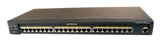
A two-page Cisco product catalog spec sheet for the FastHub 100 series of standalone, unmanaged 100BaseT Class II hubs. It covers the FastHub 112T 10/100, FastHub 116T and FastHub 124T 10/100. It gives cabling rules, cable distances, indicators, physical and environmental specifications, and ordering part numbers.
- Device
- Standalone unmanaged 100BaseT Class II hub in 12, 16 or 24 ports p. 1, 2
- Models
- FastHub 112T 10/100, FastHub 116T, FastHub 124T 10/100 p. 1
- Ports and cabling
- 100BaseTX ports for two-pair Category 5 UTP cable with RJ-45 connectors p. 1
- Throughput
- 100-Mbps peak and aggregate p. 1
- Standards
- IEEE 802.3u Class II repeater; FastHub 112T and 124T also 802.3 10 Mbps repeater compliant p. 1
- Linking hubs
- Two Class II hubs connected form a collision domain of up to 46 ports p. 1
- Cable distances
- Up to 656 ft (200 m) between end stations through one hub; 328 ft (100 m) port to end node p. 1
- Part numbers
- FastHub 112T: WS-C112T; FastHub 116T: WS-C116T; FastHub 124T: WS-C124T p. 2
- Redundant power
- Optional Cisco RPS: PWR600-AC-RPS-CAB (with DC power cables) or PWR600-AC-RPS-NCAB (without) p. 2
- AC input
- 90 to 127 or 200 to 250 VAC, 50 to 60 Hz autoranging p. 2
- Dimensions (H x W x D)
- 1.73 x 17.50 x 8.25 in. (4.4 x 44.5 x 21 cm) p. 2
- Weight
- 11 lb (5 kg) p. 2
- Operating temperature
- 23 to 113 F (-5 to 45 C); humidity 10 to 85% noncondensing p. 2
- Mounting
- 19-inch rack-mount hardware and brackets included p. 1
What this sheet walks you through
- Choosing straight-through or crossover cables to link two hubs p. 1
- Planning cable distances with one or two hubs in the path p. 1
- Reading the port, utilization, collision and power LEDs p. 1
- Ordering hubs and redundant power systems by part number p. 2
Good to know
- Only one direct 100BaseT connection between two hubs is allowed. p. 1
- The hubs are unmanaged, meant for workgroups where management is not critical. p. 1
- The sheet is headed as end of life (EOL). p. 1
Questions this sheet answers
What is the part number of the Cisco FastHub 124T?
The spec sheet lists the FastHub 124T unmanaged 100BaseTX hub as part number WS-C124T. p. 2
Can two FastHub 100 hubs be connected together?
Yes. The Class II design lets two hubs be linked into one collision domain of up to 46 ports, using a crossover cable between non-uplink ports. p. 1
How far can a FastHub 100 port be from a computer?
The maximum cable distance between a 100BaseTX port and an end node is 328 ft (100 m). p. 1
Does the FastHub 100 support redundant power?
Yes. It supports connection to the optional Cisco redundant power system (RPS), sold with or without DC power cables. p. 2
The file
Size and text
Every page · 2
Read it here
Each page as it is printed, and its words beside it, so a phone can search and copy them.
Page1of 2
Open in the PDF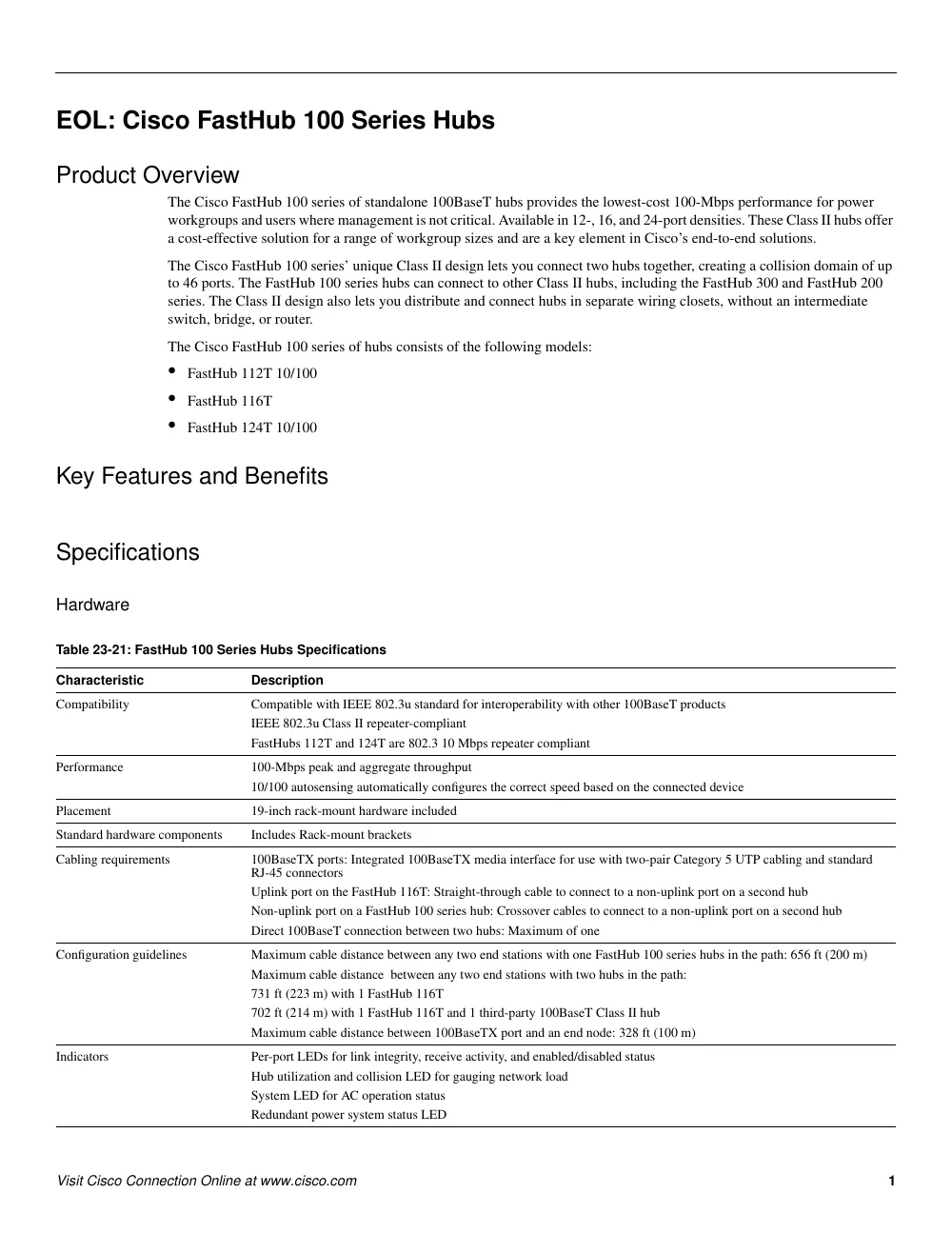
The text of page 1, from the PDF itself
EOL: Cisco FastHub 100 Series Hubs Product Overview The Cisco FastHub 100 series of standalone 100BaseT hubs provides the lowest-cost 100-Mbps performance for power workgroups and users where management is not critical. Available in 12-, 16, and 24-port densities. These Class II hubs offer a cost-effective solution for a range of workgroup sizes and are a key element in Cisco’s end-to-end solutions. The Cisco FastHub 100 series’ unique Class II design lets you connect two hubs together, creating a collision domain of up to 46 ports. The FastHub 100 series hubs can connect to other Class II hubs, including the FastHub 300 and FastHub 200 series. The Class II design also lets you distribute and connect hubs in separate wiring closets, without an intermediate switch, bridge, or router. The Cisco FastHub 100 series of hubs consists of the following models:
- FastHub 112T 10/100
- FastHub 116T
- FastHub 124T 10/100 Key Features and Benefits Specifications Hardware Table 23-21: FastHub 100 Series Hubs Specifications Characteristic
Description
Compatibility
Compatible with IEEE 802.3u standard for interoperability with other 100BaseT products IEEE 802.3u Class II repeater-compliant FastHubs 112T and 124T are 802.3 10 Mbps repeater compliant
Performance
100-Mbps peak and aggregate throughput 10/100 autosensing automatically configures the correct speed based on the connected device
Placement
19-inch rack-mount hardware included
Standard hardware components
Includes Rack-mount brackets
Cabling requirements
100BaseTX ports: Integrated 100BaseTX media interface for use with two-pair Category 5 UTP cabling and standard RJ-45 connectors Uplink port on the FastHub 116T: Straight-through cable to connect to a non-uplink port on a second hub Non-uplink port on a FastHub 100 series hub: Crossover cables to connect to a non-uplink port on a second hub Direct 100BaseT connection between two hubs: Maximum of one
Configuration guidelines
Maximum cable distance between any two end stations with one FastHub 100 series hubs in the path: 656 ft (200 m) Maximum cable distance between any two end stations with two hubs in the path: 731 ft (223 m) with 1 FastHub 116T 702 ft (214 m) with 1 FastHub 116T and 1 third-party 100BaseT Class II hub Maximum cable distance between 100BaseTX port and an end node: 328 ft (100 m)
Indicators
Per-port LEDs for link integrity, receive activity, and enabled/disabled status Hub utilization and collision LED for gauging network load System LED for AC operation status Redundant power system status LED
Visit Cisco Connection Online at www.cisco.com
1
Page2of 2
Open in the PDF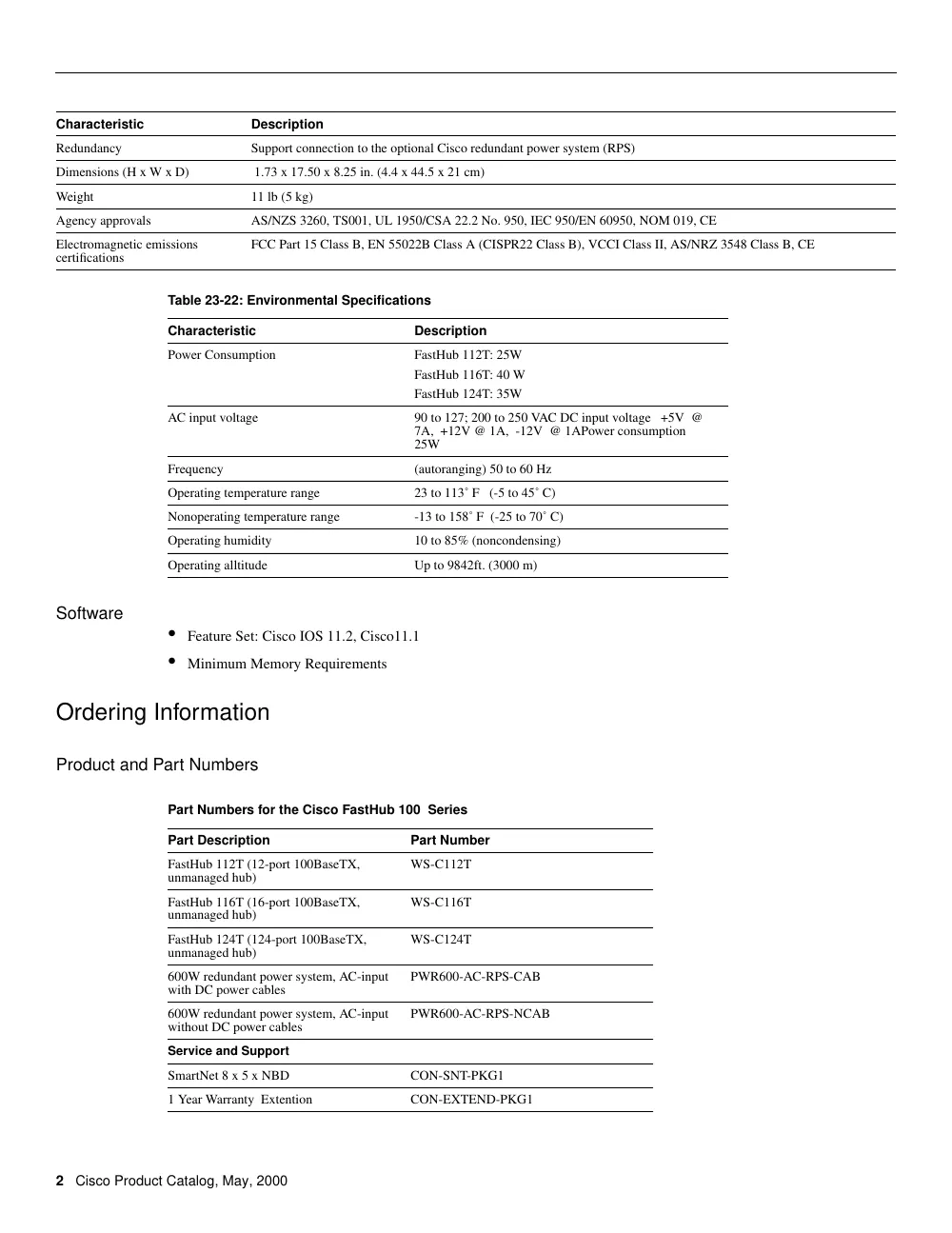
The text of page 2, from the PDF itself
CharacteristicDescriptionRedundancy
Support connection to the optional Cisco redundant power system (RPS)
Dimensions (H x W x D)
1.73 x 17.50 x 8.25 in. (4.4 x 44.5 x 21 cm)
Weight11 lb (5 kg)Agency approvals
AS/NZS 3260, TS001, UL 1950/CSA 22.2 No. 950, IEC 950/EN 60950, NOM 019, CE
Electromagnetic emissions certifications
FCC Part 15 Class B, EN 55022B Class A (CISPR22 Class B), VCCI Class II, AS/NRZ 3548 Class B, CE
Table 23-22: Environmental Specifications Characteristic
Description
Power Consumption
FastHub 112T: 25W FastHub 116T: 40 W FastHub 124T: 35W
AC input voltage
90 to 127; 200 to 250 VAC DC input voltage +5V @ 7A, +12V @ 1A, -12V @ 1APower consumption 25W
Frequency
(autoranging) 50 to 60 Hz
Operating temperature range
23 to 113˚ F (-5 to 45˚ C)
Nonoperating temperature range
-13 to 158˚ F (-25 to 70˚ C)
Operating humidity
10 to 85% (noncondensing)
Operating alltitudeUp to 9842ft. (3000 m)Software
- Feature Set: Cisco IOS 11.2, Cisco11.1
- Minimum Memory Requirements Ordering Information Product and Part Numbers Part Numbers for the Cisco FastHub 100 Series Part Description
Part Number
FastHub 112T (12-port 100BaseTX, unmanaged hub)
WS-C112T
FastHub 116T (16-port 100BaseTX, unmanaged hub)
WS-C116T
FastHub 124T (124-port 100BaseTX, unmanaged hub)
WS-C124T
600W redundant power system, AC-input with DC power cables
PWR600-AC-RPS-CAB
600W redundant power system, AC-input without DC power cables
PWR600-AC-RPS-NCABService and SupportSmartNet 8 x 5 x NBDCON-SNT-PKG1
1 Year Warranty Extention
CON-EXTEND-PKG1
2 Cisco Product Catalog, May, 2000