Manual · Beijer
QTERM-IV/P40 User's Manual
Manual64 pagesPDF 1.2 MB
User's manual for the Beijer Electronics QTERM-IV and QTERM-P40 industrial data-entry terminals: commands, QDATA setup, serial modes and hardware.
Covers · 2 models
The models it covers
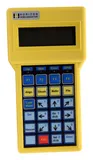
Summary
What is in it
Beijer Electronics' user's manual for the QTERM-IV and QTERM-P40, data-entry terminals for industrial applications, written for version 2.1 of the QTERM operation code. It starts with a quick start, then lists every QTERM software command, shows how to configure the terminal with a QDATA file and QSETUP, explains full-duplex, block and multidrop serial modes, and describes the handheld, battery-back and panel-mount hardware, interfaces, connector pinouts and specifications.
Its parts
- Quick Start
- QTERM Software
- Using The QDATA File
- QTERM Serial Modes
- QTERM-IV Hardware
- QTERM-P40 Hardware
- ASCII Chart
- QTERM Character Chart
- QTERM Command Summary
From the manual
Key facts from this manual
Each line names its page in the PDF.
Beijer Electronics user's manual (M01-008-00 Rev 10, March 2011) for the QTERM-IV and QTERM-P40 industrial data-entry terminals, written for version 2.1 of the QTERM operation code. It covers power-on setup, wiring, the software commands, the QDATA configuration file, the serial modes, and the hardware and specifications of each model.
- Device
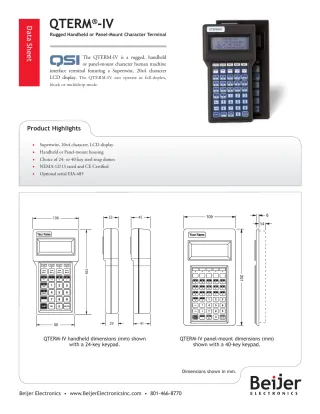
- Data-entry terminal for industrial applications, in handheld, battery-back and panel-mount versions p. 5, 43, 44
- Display
- QTERM-IV: 4-line by 20-character supertwist display; backlit and wide-temperature options p. 45, 46
- Interfaces
- QTERM-IV: EIA-232 (about 15 meters at 9600 baud), EIA-422 (about 1000 meters), 5-volt Buffered (up to 5 meters) p. 44, 45
- Connectors
- QTERM-IV handheld: 6-pin Modular or optional DB9 female; panel-mount: 2-mm connector on the PC board p. 43, 44
- Baud rates
- 9600, 4800, 2400, 1200, 600, 300, 150 p. 12
- Serial modes
- Full duplex, block and multidrop (addresses 01 to 99) p. 12
- Keypad
- 24 or 40 keys with a shift key; four or five user-programmable LEDs p. 46
- Regulator option
- QTERM-IV: runs from a 5.5 to 24 volt SELV DC source p. 46
- Battery back
- QTERM-IV handheld: six AA alkaline batteries; power-supply board with on/off switch p. 43
- Auxiliary serial port
- QTERM-IV option: DB9 (handheld) or 6-pin 2 mm (panel-mount); 1200 baud, 8n1; mates with HP SmartWand p. 47
- Digital outputs
- QTERM-IV: dig0 and dig1, about 20 mA at 0 or 5 volts; not on the EIA-422 version p. 46
- Temperature
- QTERM-IV: -40 to 85°C except display; standard display -10 to 60°C; wide-temperature display -20 to 70°C p. 48
- Firmware
- Manual written for version 2.1 of the QTERM operation code p. 5
- Software
- QDEMO demo and terminal emulator; QSETUP loads QDATA configuration files p. 8, 12
What this manual walks you through
- Setting contrast, baud rate, data format and serial mode at power-on p. 11
- Wiring the host lines and power to the connector pins p. 12, 13
- Running the QDEMO program from a PC p. 12
- Editing and loading the QDATA file to change key strings and custom characters p. 13
- Using block and multidrop serial modes p. 8
- Mounting the panel-mount QTERM-IV in a panel cutout p. 44
- Installing the EIA-422 termination resistor p. 44
- Locking the EEPROM against changes with the disable jumper p. 47
- Adding another PC board inside the handheld case p. 47
Good to know
- Power must come from an SELV source with a 5 ampere current limit on its output. p. 12
- An EIA-422 or 5-volt Buffered QTERM cannot connect directly to a PC COM port; an interface unit such as the QCOM-2 is needed. p. 12
- The regulator option should not be ordered with the battery back option. p. 43, 44
- The housing is not waterproof but can take moderate rain or splash. p. 43
- With the auxiliary port option, the QTERM-IV host port must run at 1200 baud or faster. p. 47
Questions this manual answers
How do I change the baud rate on a QTERM-IV?
Hold down any key while applying power, then use the up, down and save keys to set contrast, baud rate, data format and serial mode. p. 11
What baud rates does the QTERM-IV support?
9600, 4800, 2400, 1200, 600, 300 and 150 baud. p. 12
How far can a QTERM-IV be from the host?
About 15 meters on EIA-232 at 9600 baud, about 1000 meters on EIA-422, and up to 5 meters on 5-volt Buffered. p. 44, 45
Can a bar code wand be connected to the QTERM-IV?
Yes, with the auxiliary serial port option; the handheld DB9 mates with an HP SmartWand and runs at 1200 baud, 8n1. p. 47
What batteries does the QTERM-IV battery back take?
Six AA size alkaline batteries. p. 43
Contents
Chapters and sections
Each line opens the PDF at its page.
- FCC Compliance Statement3
- Chapter 1. Quick Start 17
- Chapter 2. QTERM Software 57
- Chapter 3. Using The QDATA File 178
- Chapter 4. QTERM Serial Modes 258
- Chapter 5. QTERM-IV Hardware 338
- Chapter 6. QTERM-P40 Hardware 419
- Appendix A. ASCII Chart 479
- Appendix B. 479
- Appendix C. QTERM Character Chart 499
- Appendix D. QTERM Command Summary 519
- Chapter 1.11
36 more lines, from page 11 on
The whole text · 10 parts
Read the manual here as text
Its text as extracted from the PDF, unedited, in parts; each page opens the PDF at that page.
The file