


Spec sheet · Allot
Allot AC-201 Spec Sheet
Spec sheet4 pagesPDF 463 KB
All 4 pages are below, each with its text.
Covers · 1 model
The models it covers
From the sheet · read page by page
Key facts from this sheet
Each line names its page in the PDF.
Product sheet for the Allot NetEnforcer, a bandwidth management and QoS policy enforcement appliance for service providers. Its ordering table lists the AC-201/2M, AC-201/10M, AC-301 and AC-401, and one shared specification list gives the interfaces, power, size, traffic classification and monitoring features. The two middle pages repeat the same features text.
- Device
- NetEnforcer policy enforcement appliance for managing bandwidth and enforcing service level agreements p. 2
- AC-201/2M
- Part No. K10202M: 2 Mbps, 256 Pipes, 2048 total VCs, 12000 connections p. 1
- AC-201/10M
- Part No. K102000: 10 Mbps, 256 Pipes, 2048 total VCs, 12000 connections p. 1
- Interfaces
- Two 10/100 Mbps half/full duplex autosense Ethernet ports, RJ-45 p. 1
- Power
- 100-240V AC, 50/60Hz, 2A p. 1
- Dimensions
- 1U, 19-inch rack mount; 1.73 in. (43.3 mm) high, 17.22 in. (437.5 mm) wide, 11.5 in. (292.8 mm) deep p. 1
- Configuration
- Remote policy configuration by web browser or command line interface p. 1
- Fail-safe
- Hardware bypass; dual configuration with hot-standby p. 1
- Traffic classification
- By IP/MAC address, protocol, TCP/UDP port, HTTP header content, ToS byte and time of day p. 1
- QoS enforcement
- Minimum/maximum bandwidth per flow, VC or Pipe; ten priority levels p. 1
- Monitoring
- 30-second granularity, historical data kept for the last 6 months; SNMP statistics p. 1
- Standards
- COPS, LDAP, DiffServ/TOS, IP Precedence, SNMP, RADIUS, ODBC p. 1
- Browsers
- MS Internet Explorer 5.01, 5.5; Netscape Navigator 4.5, 4.6, 4.7, 6.0 p. 1
- Options
- NetAccountant accounting; cache redirection and server load balancing packages p. 1
What this sheet walks you through
- Provisioning subscribers from a customer care and billing system p. 2
- Defining customers as Pipes and their policies as Virtual Channels p. 2
- How Per-Flow Queuing shares bandwidth p. 2
- Sending traffic data to billing and reporting systems p. 2
- Fault tolerance with hardware bypass and a hot-backup unit p. 2
- Marking packets with DiffServ values for end-to-end QoS p. 2
- Linking policies to an LDAP directory p. 2
Good to know
- The Total VCs figure is the maximum when all VCs are based on IP addresses and sit in the Default Pipe. p. 1
- Accounting needs the optional NetAccountant; cache redirection and server load balancing are optional software packages. p. 1
Questions this sheet answers
What is the difference between the AC-201/2M and AC-201/10M?
Bandwidth: the AC-201/2M (Part No. K10202M) handles 2 Mbps and the AC-201/10M (K102000) 10 Mbps. Both list 256 Pipes, 2048 total VCs and 12000 connections. p. 1
What network ports does the Allot NetEnforcer AC-201 have?
Two 10/100 Mbps half/full duplex autosense Ethernet interfaces with RJ-45 connectors. p. 1
What happens to traffic if the NetEnforcer fails?
If any software or hardware component fails, it switches to a hardware bypass mode and passes all traffic through. Two units can also run as active and hot-backup. p. 2
How is the NetEnforcer configured?
Policies are configured remotely through a web browser or a command line interface. p. 1
The file
Size and text
Every page · 4
Read it here
Each page as it is printed, and its words beside it, so a phone can search and copy them.
Page1of 4
Open in the PDF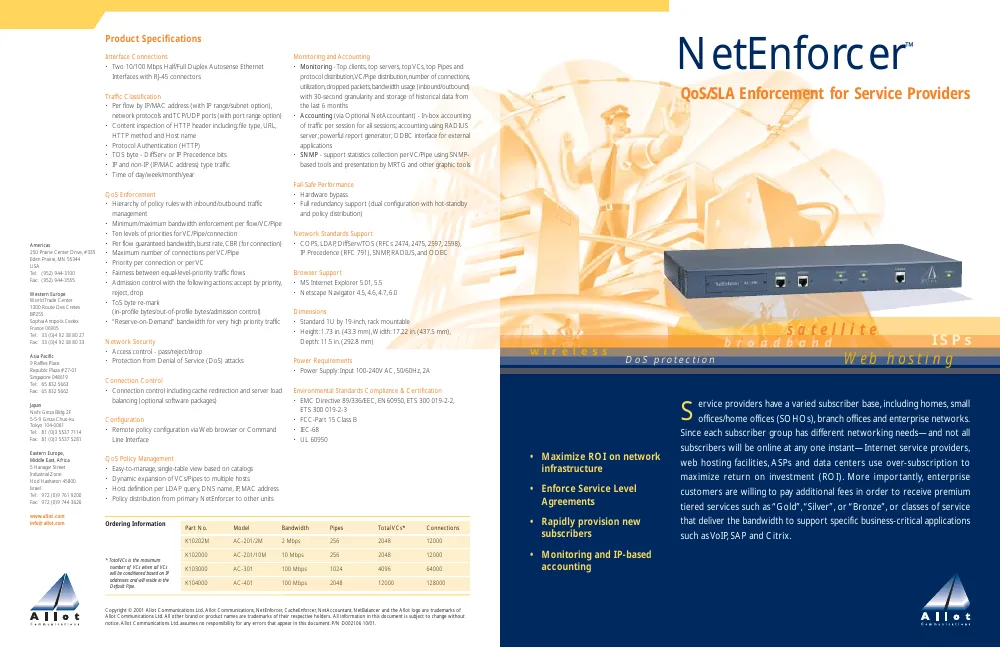
The text of page 1, from the PDF itself
Product Specifications
Traffic Classification
- Per flow by IP/MAC address (with IP range/subnet option), network protocols and TCP/UDP ports (with port range option)
- Content inspection of HTTP header including: file type, URL, HTTP method and Host name
- Protocol Authentication (HTTP)
- TOS byte - DiffServ or IP Precedence bits
- IP and non-IP (IP/MAC address) type traffic
- Time of day/week/month/year
Americas 250 Prairie Center Drive, #335 Eden Prairie, MN 55344 USA Tel: (952) 944-3100 Fax: (952) 944-3555 Western Europe World Trade Center 1300 Route Des Cretes BP255 Sophia Antipolis Cedex France 06905 Tel: 33 (0)4 92 38 80 27 Fax: 33 (0)4 92 38 80 33 Asia Pacific 9 Raffles Place Republic Plaza #27-01 Singapore 048619 Tel: 65 832 5663 Fax: 65 832 5662 Japan Nishi Ginza Bldg. 2F 5-5-9 Ginza Chuo-ku Tokyo 104-0061 Tel: 81 (0)3 5537 7114 Fax: 81 (0)3 5537 5281 Eastern Europe, Middle East, Africa 5 Hanagar Street Industrial Zone Hod Hasharon 45800 Israel Tel: 972 (0)9 761 9200 Fax: 972 (0)9 744 3626 www.allot.com info@allot.com
QoS Enforcement
- Hierarchy of policy rules with inbound/outbound traffic management
- Minimum/maximum bandwidth enforcement per flow/VC/Pipe
- Ten levels of priorities for VC/Pipe/connection
- Per flow guaranteed bandwidth, burst rate, CBR (for connection)
- Maximum number of connections per VC/Pipe
- Priority per connection or per VC
- Fairness between equal-level-priority traffic flows
- Admission control with the following actions: accept by priority, reject, drop
- ToS byte re-mark (in-profile bytes/out-of-profile bytes/admission control)
- “Reserve-on-Demand” bandwidth for very high priority traffic Network Security
- Access control - pass/reject/drop
- Protection from Denial of Service (DoS) attacks
Configuration
- Remote policy configuration via Web browser or Command Line Interface
Monitoring and Accounting
- Monitoring - Top clients, top servers, top VCs, top Pipes and protocol distribution,VC/Pipe distribution, number of connections, utilization, dropped packets, bandwidth usage (inbound/outbound) with 30-second granularity and storage of historical data from the last 6 months
- Accounting (via Optional NetAccountant) - In-box accounting of traffic per session for all sessions; accounting using RADIUS server; powerful report generator; ODBC interface for external applications
- SNMP - support statistics collection per VC/Pipe using SNMPbased tools and presentation by MRTG and other graphic tools Fail-Safe Performance
- Hardware bypass
- Full redundancy support (dual configuration with hot-standby and policy distribution) Network Standards Support
- COPS, LDAP, DiffServ/TOS (RFCs 2474, 2475, 2597, 2598), IP Precedence (RFC 791), SNMP, RADIUS, and ODBC Browser Support
- MS Internet Explorer 5.01, 5.5
- Netscape Navigator 4.5, 4.6, 4.7, 6.0 Dimensions
- Standard 1U by 19-inch, rack mountable
- Height: 1.73 in. (43.3 mm), Width: 17.22 in. (437.5 mm), Depth: 11.5 in. (292.8 mm) Power Requirements
- Power Supply: Input 100-240V AC, 50/60Hz, 2A
satellite
b r o a d b a n d DoS protection
Environmental Standards Compliance & Certification
- EMC Directive 89/336/EEC, EN60950, ETS 300 019-2-2, ETS 300 019-2-3
- FCC-Part 15 Class B
- IEC-68
- UL 60950
- Enforce Service Level Agreements
Part No.ModelBandwidthPipesTotal VCs*ConnectionsK10202MAC-201/2M2 Mbps256204812000K102000AC-201/10M10 Mbps256204812000K103000AC-301100 Mbps1024409664000K104000AC-401100 Mbps204812000128000
Copyright © 2001 Allot Communications Ltd. Allot Communications, NetEnforcer, CacheEnforcer, NetAccountant, NetBalancer and the Allot logo are trademarks of Allot Communications Ltd. All other brand or product names are trademarks of their respective holders. All information in this document is subject to change without notice. Allot Communications Ltd. assumes no responsibility for any errors that appear in this document. P/N D002106 10/01.
- Rapidly provision new subscribers
- Monitoring and IP-based accounting
ISPs
Web hosting
ervice providers have a varied subscriber base, including homes, small offices/home offices (SOHOs), branch offices and enterprise networks. Since each subscriber group has different networking needs - and not all subscribers will be online at any one instant - Internet service providers, web hosting facilities, ASPs and data centers use over-subscription to maximize return on investment (ROI). More importantly, enterprise customers are willing to pay additional fees in order to receive premium tiered services such as “Gold”, “Silver”, or “Bronze”, or classes of service that deliver the bandwidth to support specific business-critical applications such as VoIP, SAP and Citrix.
S
- Maximize ROI on network infrastructure
QoS Policy Management
- Easy-to-manage, single-table view based on catalogs
- Dynamic expansion of VCs/Pipes to multiple hosts
- Host definition per LDAP query, DNS name, IP, MAC address
- Policy distribution from primary NetEnforcer to other units
- Total VCs is the maximum number of VCs when all VCs will be conditioned based on IP addresses and will reside in the Default Pipe.
QoS/SLA Enforcement for Service Providers
w i r e l e s s
Connection Control
- Connection control including cache redirection and server load balancing (optional software packages)
Ordering InformationNetEnforcer™
Interface Connections
- Two 10/100 Mbps Half/Full Duplex Autosense Ethernet Interfaces with RJ-45 connectors
Page2of 4
Open in the PDF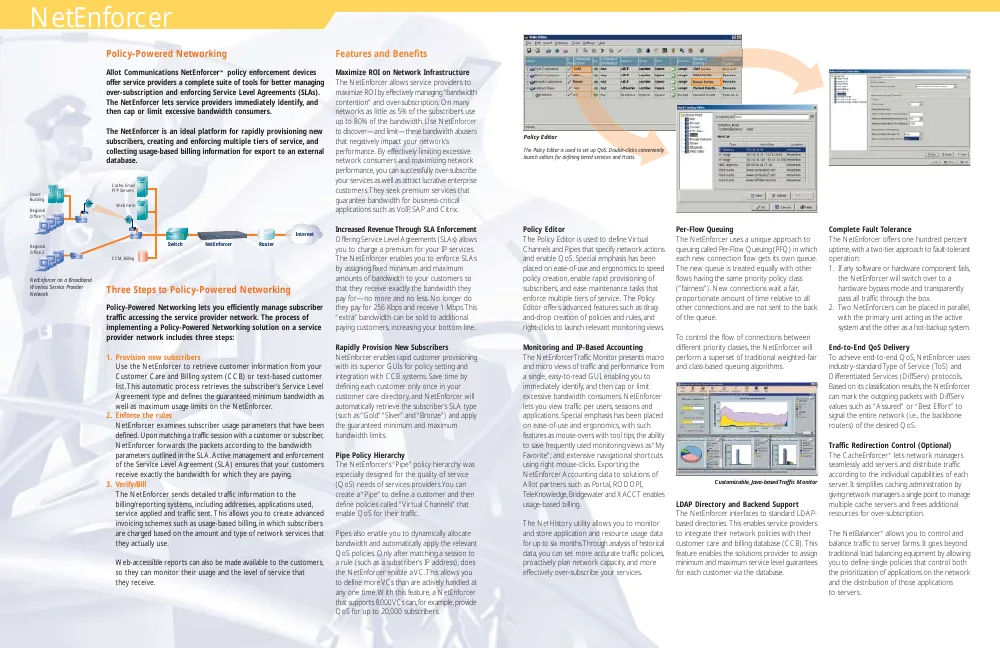
The text of page 2, from the PDF itself
NetEnforcer Policy-Powered Networking
Features and Benefits
Allot Communications NetEnforcer™ policy enforcement devices offer service providers a complete suite of tools for better managing over-subscription and enforcing Service Level Agreements (SLAs). The NetEnforcer lets service providers immediately identify, and then cap or limit excessive bandwidth consumers.
Maximize ROI on Network Infrastructure The NetEnforcer allows service providers to maximize ROI by effectively managing “bandwidth contention” and over-subscription. On many networks as little as 5% of the subscribers use up to 80% of the bandwidth. Use NetEnforcer to discover - and limit - these bandwidth abusers that negatively impact your network’s performance. By effectively limiting excessive network consumers and maximizing network performance, you can successfully over-subscribe your services as well as attract lucrative enterprise customers. They seek premium services that guarantee bandwidth for business-critical applications such as VoIP, SAP and Citrix.
The NetEnforcer is an ideal platform for rapidly provisioning new subscribers, creating and enforcing multiple tiers of service, and collecting usage-based billing information for export to an external database.
Smart Building
Cache, Email FTP Servers Web Farm
Regional Office 1Internet SwitchRegional Office 2NetEnforcerRouterCCM, Billing
NetEnforcer on a Broadband Wireless Service Provider Network
Three Steps to Policy-Powered Networking Policy-Powered Networking lets you efficiently manage subscriber traffic accessing the service provider network. The process of implementing a Policy-Powered Networking solution on a service provider network includes three steps: 1. Provision new subscribers Use the NetEnforcer to retrieve customer information from your Customer Care and Billing system (CCB) or text-based customer list. This automatic process retrieves the subscriber’s Service Level Agreement type and defines the guaranteed minimum bandwidth as well as maximum usage limits on the NetEnforcer. 2. Enforce the rules NetEnforcer examines subscriber usage parameters that have been defined. Upon matching a traffic session with a customer or subscriber, NetEnforcer forwards the packets according to the bandwidth parameters outlined in the SLA. Active management and enforcement of the Service Level Agreement (SLA) ensures that your customers receive exactly the bandwidth for which they are paying. 3. Verify/Bill The NetEnforcer sends detailed traffic information to the billing/reporting systems, including addresses, applications used, service applied and traffic sent. This allows you to create advanced invoicing schemes such as usage-based billing, in which subscribers are charged based on the amount and type of network services that they actually use. Web-accessible reports can also be made available to the customers, so they can monitor their usage and the level of service that they receive.
Policy Editor The Policy Editor is used to set up QoS. Double-clicks conveniently launch editors for defining tiered services and Hosts.
Increased Revenue Through SLA Enforcement Offering Service Level Agreements (SLAs) allows you to charge a premium for your IP services. The NetEnforcer enables you to enforce SLAs by assigning fixed minimum and maximum amounts of bandwidth to your customers so that they receive exactly the bandwidth they pay for - no more and no less. No longer do they pay for 256 Kbps and receive 1 Mbps. This “extra” bandwidth can be sold to additional paying customers, increasing your bottom line.
Policy Editor The Policy Editor is used to define Virtual Channels and Pipes that specify network actions and enable QoS. Special emphasis has been placed on ease-of-use and ergonomics to speed policy creation, enable rapid provisioning of subscribers, and ease maintenance tasks that enforce multiple tiers of service. The Policy Editor offers advanced features such as dragand-drop creation of policies and rules, and right-clicks to launch relevant monitoring views.
Rapidly Provision New Subscribers NetEnforcer enables rapid customer provisioning with its superior GUIs for policy setting and integration with CCB systems. Save time by defining each customer only once in your customer care directory, and NetEnforcer will automatically retrieve the subscriber’s SLA type (such as “Gold” “Sliver” and “Bronze”) and apply the guaranteed minimum and maximum bandwidth limits.
Monitoring and IP-Based Accounting The NetEnforcer Traffic Monitor presents macro and micro views of traffic and performance from a single, easy-to-read GUI, enabling you to immediately identify, and then cap or limit excessive bandwidth consumers. NetEnforcer lets you view traffic per users, sessions and applications. Special emphasis has been placed on ease-of-use and ergonomics, with such features as mouse-overs with tool tips; the ability to save frequently used monitoring views as “My Favorite”; and extensive navigational shortcuts using right mouse-clicks. Exporting the NetEnforcer Accounting data to solutions of Allot partners such as Portal, RODOPI, TeleKnowledge, Bridgewater and XACCT enables usage-based billing.
Pipe Policy Hierarchy The NetEnforcer’s “Pipe” policy hierarchy was especially designed for the quality of service (QoS) needs of services providers. You can create a “Pipe” to define a customer and then define policies called “Virtual Channels” that enable QoS for their traffic. Pipes also enable you to dynamically allocate bandwidth and automatically apply the relevant QoS policies. Only after matching a session to a rule (such as a subscriber‘s IP address), does the NetEnforcer enable a VC. This allows you to define more VCs than are actively handled at any one time. With this feature, a NetEnforcer that supports 8,000 VCs can, for example, provide QoS for up to 20,000 subscribers.
The NetHistory utility allows you to monitor and store application and resource usage data for up to six months.Through analysis of historical data, you can set more accurate traffic policies, proactively plan network capacity, and more effectively over-subscribe your services.
Per-Flow Queuing The NetEnforcer uses a unique approach to queuing called Per-Flow Queuing (PFQ) in which each new connection flow gets its own queue. The new queue is treated equally with other flows having the same priority policy class (“fairness”). New connections wait a fair, proportionate amount of time relative to all other connections and are not sent to the back of the queue. To control the flow of connections between different priority classes, the NetEnforcer will perform a superset of traditional weighted-fair and class-based queuing algorithms.
Customizable, Java-based Traffic Monitor
LDAP Directory and Backend Support The NetEnforcer interfaces to standard LDAPbased directories. This enables service providers to integrate their network policies with their customer care and billing database (CCB). This feature enables the solutions provider to assign minimum and maximum service level guarantees for each customer via the database.
Complete Fault Tolerance The NetEnforcer offers one hundred percent uptime, with a two-tier approach to fault-tolerant operation: 1. If any software or hardware component fails, the NetEnforcer will switch over to a hardware bypass mode and transparently pass all traffic through the box. 2. Two NetEnforcers can be placed in parallel, with the primary unit acting as the active system and the other as a hot-backup system. End-to-End QoS Delivery To achieve end-to-end QoS, NetEnforcer uses industry-standard Type of Service (ToS) and Differentiated Services (DiffServ) protocols. Based on its classification results, the NetEnforcer can mark the outgoing packets with DiffServ values such as “Assured” or “Best Effort” to signal the entire network (i.e., the backbone routers) of the desired QoS. Traffic Redirection Control (Optional) The CacheEnforcer™ lets network managers seamlessly add servers and distribute traffic according to the individual capabilities of each server. It simplifies caching administration by giving network managers a single point to manage multiple cache servers and frees additional resources for over-subscription. The NetBalancer™ allows you to control and balance traffic to server farms. It goes beyond traditional load balancing equipment by allowing you to define single policies that control both the prioritization of applications on the network and the distribution of those applications to servers.
Page3of 4
Open in the PDF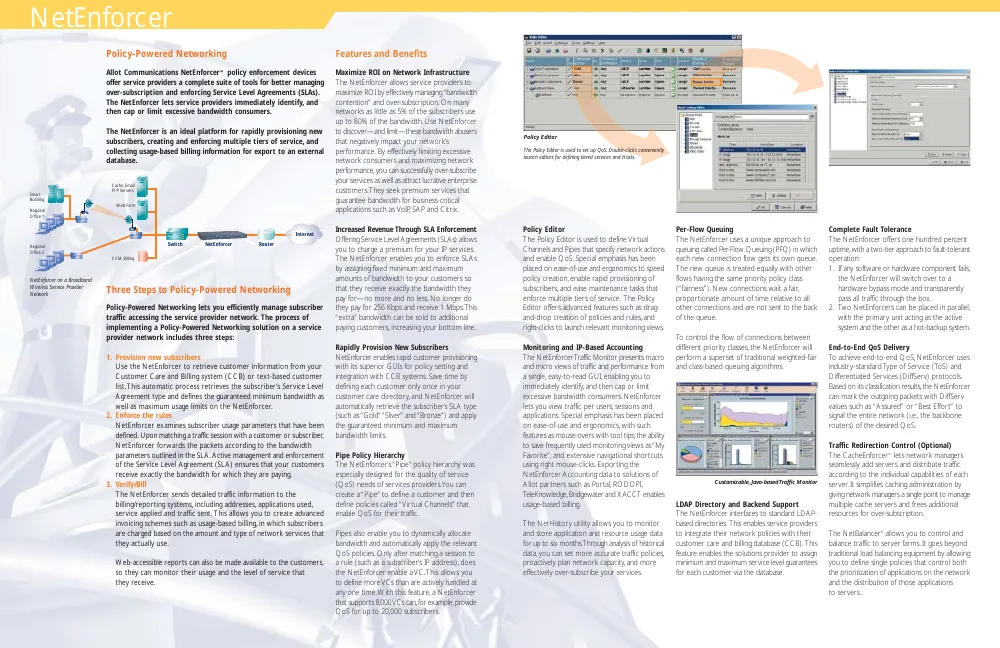
The text of page 3, from the PDF itself
NetEnforcer Policy-Powered Networking
Features and Benefits
Allot Communications NetEnforcer™ policy enforcement devices offer service providers a complete suite of tools for better managing over-subscription and enforcing Service Level Agreements (SLAs). The NetEnforcer lets service providers immediately identify, and then cap or limit excessive bandwidth consumers.
Maximize ROI on Network Infrastructure The NetEnforcer allows service providers to maximize ROI by effectively managing “bandwidth contention” and over-subscription. On many networks as little as 5% of the subscribers use up to 80% of the bandwidth. Use NetEnforcer to discover - and limit - these bandwidth abusers that negatively impact your network’s performance. By effectively limiting excessive network consumers and maximizing network performance, you can successfully over-subscribe your services as well as attract lucrative enterprise customers. They seek premium services that guarantee bandwidth for business-critical applications such as VoIP, SAP and Citrix.
The NetEnforcer is an ideal platform for rapidly provisioning new subscribers, creating and enforcing multiple tiers of service, and collecting usage-based billing information for export to an external database.
Smart Building
Cache, Email FTP Servers Web Farm
Regional Office 1Internet SwitchRegional Office 2NetEnforcerRouterCCM, Billing
NetEnforcer on a Broadband Wireless Service Provider Network
Three Steps to Policy-Powered Networking Policy-Powered Networking lets you efficiently manage subscriber traffic accessing the service provider network. The process of implementing a Policy-Powered Networking solution on a service provider network includes three steps: 1. Provision new subscribers Use the NetEnforcer to retrieve customer information from your Customer Care and Billing system (CCB) or text-based customer list. This automatic process retrieves the subscriber’s Service Level Agreement type and defines the guaranteed minimum bandwidth as well as maximum usage limits on the NetEnforcer. 2. Enforce the rules NetEnforcer examines subscriber usage parameters that have been defined. Upon matching a traffic session with a customer or subscriber, NetEnforcer forwards the packets according to the bandwidth parameters outlined in the SLA. Active management and enforcement of the Service Level Agreement (SLA) ensures that your customers receive exactly the bandwidth for which they are paying. 3. Verify/Bill The NetEnforcer sends detailed traffic information to the billing/reporting systems, including addresses, applications used, service applied and traffic sent. This allows you to create advanced invoicing schemes such as usage-based billing, in which subscribers are charged based on the amount and type of network services that they actually use. Web-accessible reports can also be made available to the customers, so they can monitor their usage and the level of service that they receive.
Policy Editor The Policy Editor is used to set up QoS. Double-clicks conveniently launch editors for defining tiered services and Hosts.
Increased Revenue Through SLA Enforcement Offering Service Level Agreements (SLAs) allows you to charge a premium for your IP services. The NetEnforcer enables you to enforce SLAs by assigning fixed minimum and maximum amounts of bandwidth to your customers so that they receive exactly the bandwidth they pay for - no more and no less. No longer do they pay for 256 Kbps and receive 1 Mbps. This “extra” bandwidth can be sold to additional paying customers, increasing your bottom line.
Policy Editor The Policy Editor is used to define Virtual Channels and Pipes that specify network actions and enable QoS. Special emphasis has been placed on ease-of-use and ergonomics to speed policy creation, enable rapid provisioning of subscribers, and ease maintenance tasks that enforce multiple tiers of service. The Policy Editor offers advanced features such as dragand-drop creation of policies and rules, and right-clicks to launch relevant monitoring views.
Rapidly Provision New Subscribers NetEnforcer enables rapid customer provisioning with its superior GUIs for policy setting and integration with CCB systems. Save time by defining each customer only once in your customer care directory, and NetEnforcer will automatically retrieve the subscriber’s SLA type (such as “Gold” “Sliver” and “Bronze”) and apply the guaranteed minimum and maximum bandwidth limits.
Monitoring and IP-Based Accounting The NetEnforcer Traffic Monitor presents macro and micro views of traffic and performance from a single, easy-to-read GUI, enabling you to immediately identify, and then cap or limit excessive bandwidth consumers. NetEnforcer lets you view traffic per users, sessions and applications. Special emphasis has been placed on ease-of-use and ergonomics, with such features as mouse-overs with tool tips; the ability to save frequently used monitoring views as “My Favorite”; and extensive navigational shortcuts using right mouse-clicks. Exporting the NetEnforcer Accounting data to solutions of Allot partners such as Portal, RODOPI, TeleKnowledge, Bridgewater and XACCT enables usage-based billing.
Pipe Policy Hierarchy The NetEnforcer’s “Pipe” policy hierarchy was especially designed for the quality of service (QoS) needs of services providers. You can create a “Pipe” to define a customer and then define policies called “Virtual Channels” that enable QoS for their traffic. Pipes also enable you to dynamically allocate bandwidth and automatically apply the relevant QoS policies. Only after matching a session to a rule (such as a subscriber‘s IP address), does the NetEnforcer enable a VC. This allows you to define more VCs than are actively handled at any one time. With this feature, a NetEnforcer that supports 8,000 VCs can, for example, provide QoS for up to 20,000 subscribers.
The NetHistory utility allows you to monitor and store application and resource usage data for up to six months.Through analysis of historical data, you can set more accurate traffic policies, proactively plan network capacity, and more effectively over-subscribe your services.
Per-Flow Queuing The NetEnforcer uses a unique approach to queuing called Per-Flow Queuing (PFQ) in which each new connection flow gets its own queue. The new queue is treated equally with other flows having the same priority policy class (“fairness”). New connections wait a fair, proportionate amount of time relative to all other connections and are not sent to the back of the queue. To control the flow of connections between different priority classes, the NetEnforcer will perform a superset of traditional weighted-fair and class-based queuing algorithms.
Customizable, Java-based Traffic Monitor
LDAP Directory and Backend Support The NetEnforcer interfaces to standard LDAPbased directories. This enables service providers to integrate their network policies with their customer care and billing database (CCB). This feature enables the solutions provider to assign minimum and maximum service level guarantees for each customer via the database.
Complete Fault Tolerance The NetEnforcer offers one hundred percent uptime, with a two-tier approach to fault-tolerant operation: 1. If any software or hardware component fails, the NetEnforcer will switch over to a hardware bypass mode and transparently pass all traffic through the box. 2. Two NetEnforcers can be placed in parallel, with the primary unit acting as the active system and the other as a hot-backup system. End-to-End QoS Delivery To achieve end-to-end QoS, NetEnforcer uses industry-standard Type of Service (ToS) and Differentiated Services (DiffServ) protocols. Based on its classification results, the NetEnforcer can mark the outgoing packets with DiffServ values such as “Assured” or “Best Effort” to signal the entire network (i.e., the backbone routers) of the desired QoS. Traffic Redirection Control (Optional) The CacheEnforcer™ lets network managers seamlessly add servers and distribute traffic according to the individual capabilities of each server. It simplifies caching administration by giving network managers a single point to manage multiple cache servers and frees additional resources for over-subscription. The NetBalancer™ allows you to control and balance traffic to server farms. It goes beyond traditional load balancing equipment by allowing you to define single policies that control both the prioritization of applications on the network and the distribution of those applications to servers.
Page4of 4
Open in the PDF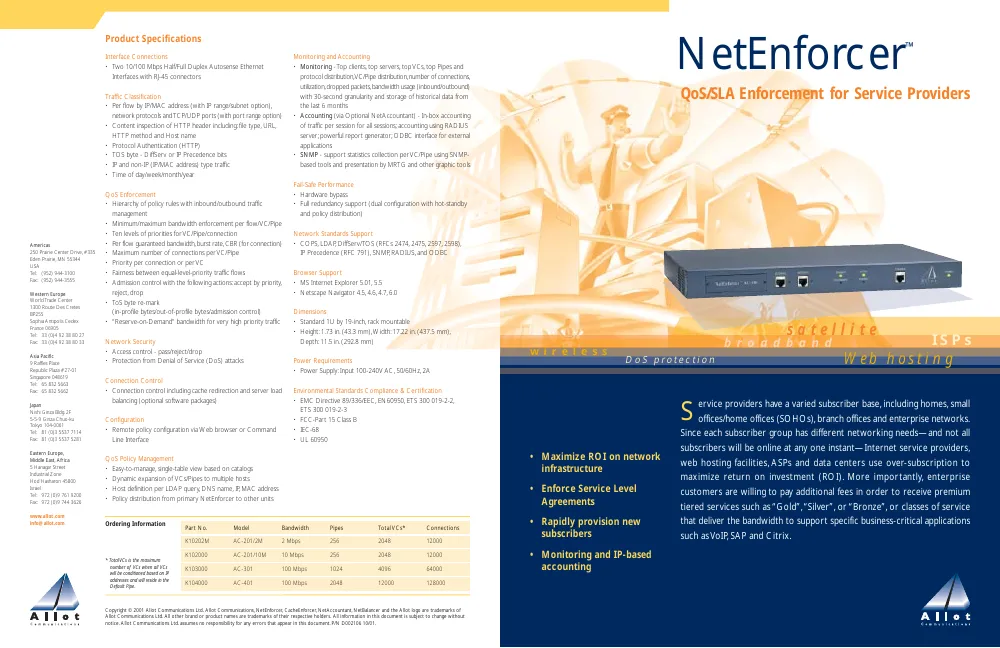
The text of page 4, from the PDF itself
Product Specifications
Traffic Classification
- Per flow by IP/MAC address (with IP range/subnet option), network protocols and TCP/UDP ports (with port range option)
- Content inspection of HTTP header including: file type, URL, HTTP method and Host name
- Protocol Authentication (HTTP)
- TOS byte - DiffServ or IP Precedence bits
- IP and non-IP (IP/MAC address) type traffic
- Time of day/week/month/year
Americas 250 Prairie Center Drive, #335 Eden Prairie, MN 55344 USA Tel: (952) 944-3100 Fax: (952) 944-3555 Western Europe World Trade Center 1300 Route Des Cretes BP255 Sophia Antipolis Cedex France 06905 Tel: 33 (0)4 92 38 80 27 Fax: 33 (0)4 92 38 80 33 Asia Pacific 9 Raffles Place Republic Plaza #27-01 Singapore 048619 Tel: 65 832 5663 Fax: 65 832 5662 Japan Nishi Ginza Bldg. 2F 5-5-9 Ginza Chuo-ku Tokyo 104-0061 Tel: 81 (0)3 5537 7114 Fax: 81 (0)3 5537 5281 Eastern Europe, Middle East, Africa 5 Hanagar Street Industrial Zone Hod Hasharon 45800 Israel Tel: 972 (0)9 761 9200 Fax: 972 (0)9 744 3626 www.allot.com info@allot.com
QoS Enforcement
- Hierarchy of policy rules with inbound/outbound traffic management
- Minimum/maximum bandwidth enforcement per flow/VC/Pipe
- Ten levels of priorities for VC/Pipe/connection
- Per flow guaranteed bandwidth, burst rate, CBR (for connection)
- Maximum number of connections per VC/Pipe
- Priority per connection or per VC
- Fairness between equal-level-priority traffic flows
- Admission control with the following actions: accept by priority, reject, drop
- ToS byte re-mark (in-profile bytes/out-of-profile bytes/admission control)
- “Reserve-on-Demand” bandwidth for very high priority traffic Network Security
- Access control - pass/reject/drop
- Protection from Denial of Service (DoS) attacks
Configuration
- Remote policy configuration via Web browser or Command Line Interface
Monitoring and Accounting
- Monitoring - Top clients, top servers, top VCs, top Pipes and protocol distribution,VC/Pipe distribution, number of connections, utilization, dropped packets, bandwidth usage (inbound/outbound) with 30-second granularity and storage of historical data from the last 6 months
- Accounting (via Optional NetAccountant) - In-box accounting of traffic per session for all sessions; accounting using RADIUS server; powerful report generator; ODBC interface for external applications
- SNMP - support statistics collection per VC/Pipe using SNMPbased tools and presentation by MRTG and other graphic tools Fail-Safe Performance
- Hardware bypass
- Full redundancy support (dual configuration with hot-standby and policy distribution) Network Standards Support
- COPS, LDAP, DiffServ/TOS (RFCs 2474, 2475, 2597, 2598), IP Precedence (RFC 791), SNMP, RADIUS, and ODBC Browser Support
- MS Internet Explorer 5.01, 5.5
- Netscape Navigator 4.5, 4.6, 4.7, 6.0 Dimensions
- Standard 1U by 19-inch, rack mountable
- Height: 1.73 in. (43.3 mm), Width: 17.22 in. (437.5 mm), Depth: 11.5 in. (292.8 mm) Power Requirements
- Power Supply: Input 100-240V AC, 50/60Hz, 2A
satellite
b r o a d b a n d DoS protection
Environmental Standards Compliance & Certification
- EMC Directive 89/336/EEC, EN60950, ETS 300 019-2-2, ETS 300 019-2-3
- FCC-Part 15 Class B
- IEC-68
- UL 60950
- Enforce Service Level Agreements
Part No.ModelBandwidthPipesTotal VCs*ConnectionsK10202MAC-201/2M2 Mbps256204812000K102000AC-201/10M10 Mbps256204812000K103000AC-301100 Mbps1024409664000K104000AC-401100 Mbps204812000128000
Copyright © 2001 Allot Communications Ltd. Allot Communications, NetEnforcer, CacheEnforcer, NetAccountant, NetBalancer and the Allot logo are trademarks of Allot Communications Ltd. All other brand or product names are trademarks of their respective holders. All information in this document is subject to change without notice. Allot Communications Ltd. assumes no responsibility for any errors that appear in this document. P/N D002106 10/01.
- Rapidly provision new subscribers
- Monitoring and IP-based accounting
ISPs
Web hosting
ervice providers have a varied subscriber base, including homes, small offices/home offices (SOHOs), branch offices and enterprise networks. Since each subscriber group has different networking needs - and not all subscribers will be online at any one instant - Internet service providers, web hosting facilities, ASPs and data centers use over-subscription to maximize return on investment (ROI). More importantly, enterprise customers are willing to pay additional fees in order to receive premium tiered services such as “Gold”, “Silver”, or “Bronze”, or classes of service that deliver the bandwidth to support specific business-critical applications such as VoIP, SAP and Citrix.
S
- Maximize ROI on network infrastructure
QoS Policy Management
- Easy-to-manage, single-table view based on catalogs
- Dynamic expansion of VCs/Pipes to multiple hosts
- Host definition per LDAP query, DNS name, IP, MAC address
- Policy distribution from primary NetEnforcer to other units
- Total VCs is the maximum number of VCs when all VCs will be conditioned based on IP addresses and will reside in the Default Pipe.
QoS/SLA Enforcement for Service Providers
w i r e l e s s
Connection Control
- Connection control including cache redirection and server load balancing (optional software packages)
Ordering InformationNetEnforcer™
Interface Connections
- Two 10/100 Mbps Half/Full Duplex Autosense Ethernet Interfaces with RJ-45 connectors